

Sources on the life of Antonello da Messina are scarce and uncertain. In his Vite, Vasari¹ describes him as a pupil of Jan van Eyck and the inventor of oil painting. We now know this information to be incorrect, but it nevertheless gives a sense of the artist’s stature, a greatness also confirmed by the – unfortunately very few – works that have survived. Damage, destruction, loss and theft (the most recent, sensational case occurring at MuMe, the Regional Museum of Messina) have reduced the number of his surviving works, without diminishing the innovative significance of the Sicilian artist. Recognised as one of the greatest masters of the Renaissance, Antonello da Messina succeeded like no other in combining the achievements of Flemish art with the traditions of Italian art, producing results that still astonish today for their originality and harmony.
A fragmentary and uncertain biography
Fifteenth-century Messina was a flourishing economic centre, a crossroads for goods and people travelling between the East and Flanders. Under the influence of the Neapolitan Angevins first and the Aragonese later, the city enjoyed a period of political stability and prosperity and, although it did not distinguish itself through cultural achievements of its own, it readily embraced innovations arriving from elsewhere.
Among these was Flemish painting, favoured by the powerful Alfonso of Aragon and brought to the island through its intense commercial activity. It was in this context that Antonello, the son of a stonemason, was born sometime between 1425 and 1430. While still very young, he travelled to Naples (between 1445 and 1455) to learn the trade in Colantonio’s workshop, where he was introduced to the Northern style.
After returning home, by 1457 he had already established his own business and worked on numerous commissions between Sicily and Calabria, at least until 1465, after which he disappeared from the historical record for a time. He reappeared in documentary sources only six years later. We know nothing about this period, but the achievements of his work after 1470 have led scholars to suggest that he travelled to mainland Italy, where Antonello may have encountered the works of Beato Angelico, Masaccio and Piero della Francesca. What is certain, however, is his stay in Venice, between 1475 and the first few months of the following year. A brief stay in Milan at the Sforza court is also likely, followed by his definitive return to Messina, where he died in 1479.
His son Jacobello, who inherited his possessions and workshop, where he had already been working for some time, undertook to complete his father’s commissions, but no one – neither he nor the other pupils – would succeed in matching the greatness of the master.
Antonello da Messina’s work: a perfect synthesis of Northern and Italian art
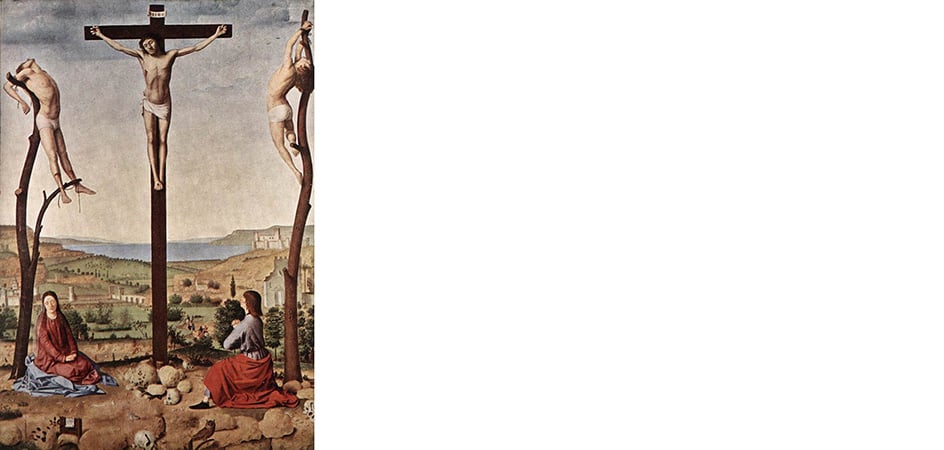
Antonello da Messina embraced the innovations of Northern art from the very beginning of his career; rather than simply imitating them, he developed a highly balanced personal interpretation. The characteristic elements of the tradition north of the Alps – the taste for landscapes and naturalistic details, the meticulous depiction of settings and objects, the realism of figures and facial features, and the colours and light, also made possible by the oil painting technique – increasingly blend with the Italian artistic language of central and northern Italy. Masterful examples of this remarkable ability to bring the two traditions together are San Gerolamo nello studio in London (c. 1475, National Gallery) and La Crocifissione in Antwerp (1475, Koninklijk Museum voor Schone Kunsten).
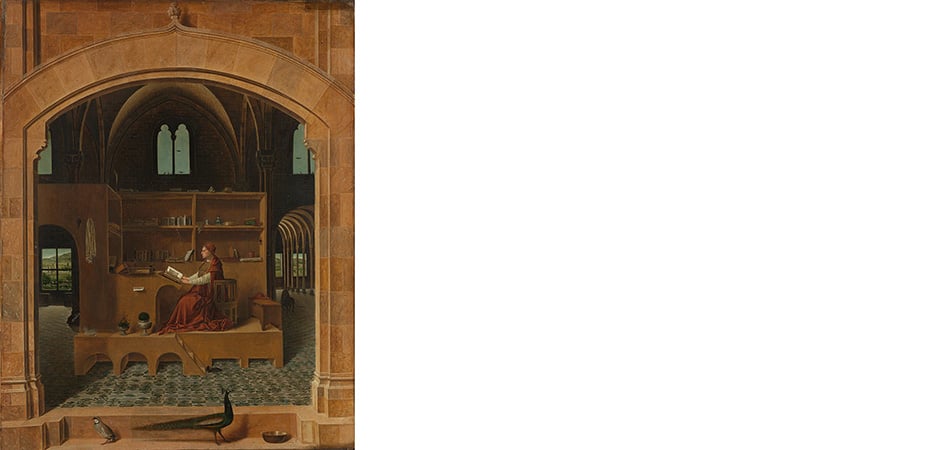
In the former, the saint is shown at his writing desk within a Gothic-style interior, rendered with extraordinary attention to even the smallest details (note, among others, the floor, the vase at his feet and the symbolic animals). Through the windows, we glimpse a clear, orderly landscape reminiscent of those painted by Petrus Christus, a pupil of Van Eyck. And yet, the quiet composure of the figure and the carefully balanced composition are clearly rooted in the Italian tradition. Similarly, the wealth of narrative detail in the background and the handling of light in the Antwerp Crocifissione reveal its Northern inspiration, while the organisation of space and rigorous use of perspective, with the towering crosses in the foreground, clearly reflect the influence of Italian art.
The Ecce Homo paintings and variations on the theme
A typically Flemish subject, the Ecce Homo (Christ wearing the crown of thorns and presented to the people by Pontius Pilate) appears quite frequently in Antonello’s work. According to the generally accepted dating, his earliest Ecce Homo dates from 1465: a double-sided panel now held at the Museo Nazionale d’Abruzzo. This was followed by the Ecce Homo in New York (c. 1470, Metropolitan Museum), the slightly later version at the Galleria Spinola in Genoa, and finally the Piacenza panel (Collegio Alberoni), dating from around 1473. Another Ecce Homo, once in Vienna, is thought to have followed, but was sadly lost during the Second World War. Comparing these different versions allows us to clearly trace the development of Antonello’s work and the influences that shaped it.
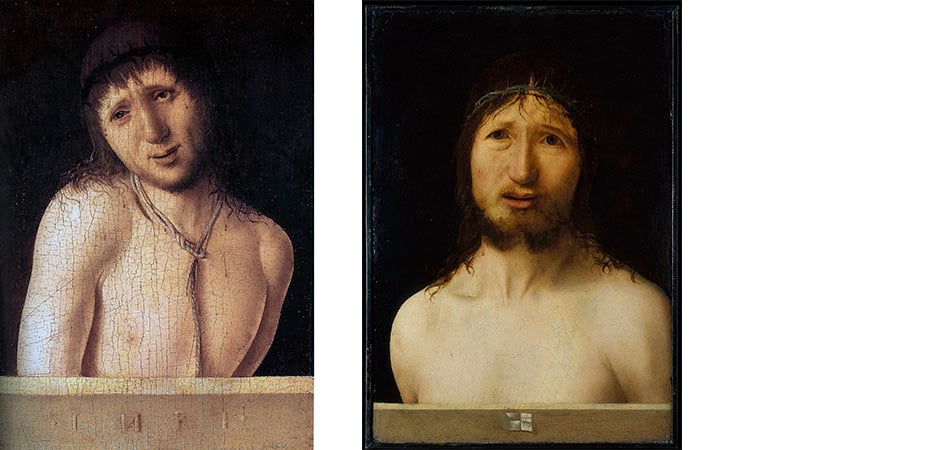
Over time, the initially more frontal and static pose develops a more pronounced twist, further emphasised by the interplay of light and shadow across Christ’s body and by the rope tied around his neck. The meticulous attention to detail – the strands of hair, the light beard, the tears that appear in the final version, creating an increasingly poignant effect – follows Northern conventions of representation, while also reflecting the approach to space typical of Italian art. The painted cartellino, dated and signed and found in many of the versions, also appears to be Italian in origin – more specifically, Squarcionesque², according to critics. These elements have led historians to suggest that Antonello may have travelled to the Veneto region as early as the late 1460s or early 1470s.
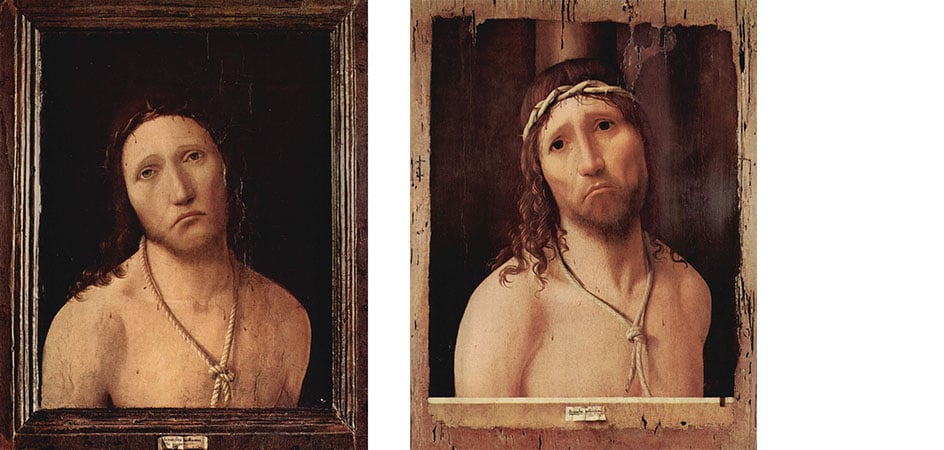
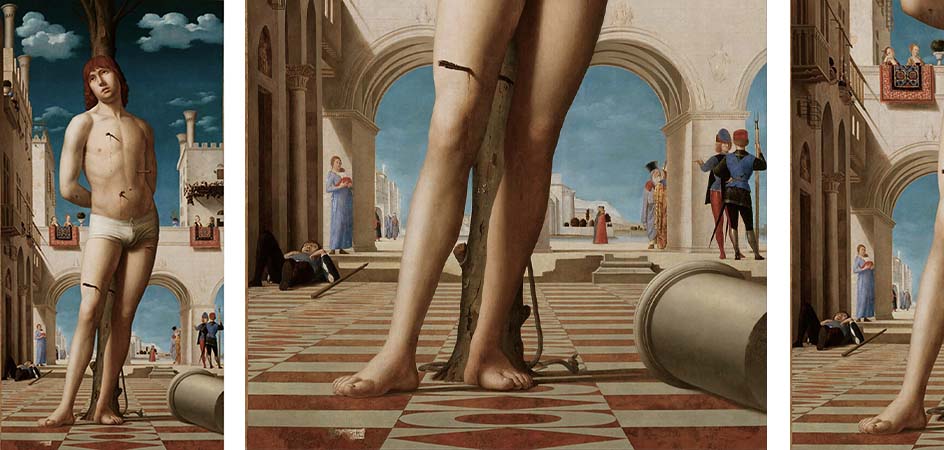
On closer inspection, the Piacenza panel is a variation on the Ecce Homo: a Cristo flagellato legato alla colonna, just as San Sebastiano in Dresden (1475–1476, Gemäldegalerie), the most Italian of Antonello’s paintings, is also shown bound to a column. The influence of Piero della Francesca’s statuesque nudes, Mantegna’s approach to the human figure and Bellini’s artistic solutions is unmistakable, all brought together in a composition of exceptional elegance and masterful perspective. The background, which in other paintings has a more distinctly Northern character, here pays tribute to the Italian Renaissance tradition, while still displaying exquisite touches of virtuosity, such as the young women conversing on the balcony or the men seen from behind in the lower right-hand corner.
When figures become people: the portraits
Antonello’s skill as a portraitist is undisputed. Although portraiture was already well established in Italy, it flourished particularly in Flanders, thanks to the great Jan van Eyck. Yet it was Petrus Christus – whose works had probably circulated in southern Italy – who had the greatest influence on Antonello, particularly in the late 1460s, when he began to explore the genre himself. The echoes of the Flemish painter’s style are numerous: the three-quarter view, unusual in Italy at the time; the clear, direct lighting that gives volume to the face; the contemporary clothing, rendered with an almost tactile sense of texture; and the sitter’s gaze directed at the viewer. Antonello, however, introduced innovations of his own, including a heightened expressiveness (almost entirely absent from the Northern school). He also omitted the hands altogether and placed his sitters – Sicilian and Venetian patrons – against a solid dark background, with no architectural setting or framing.
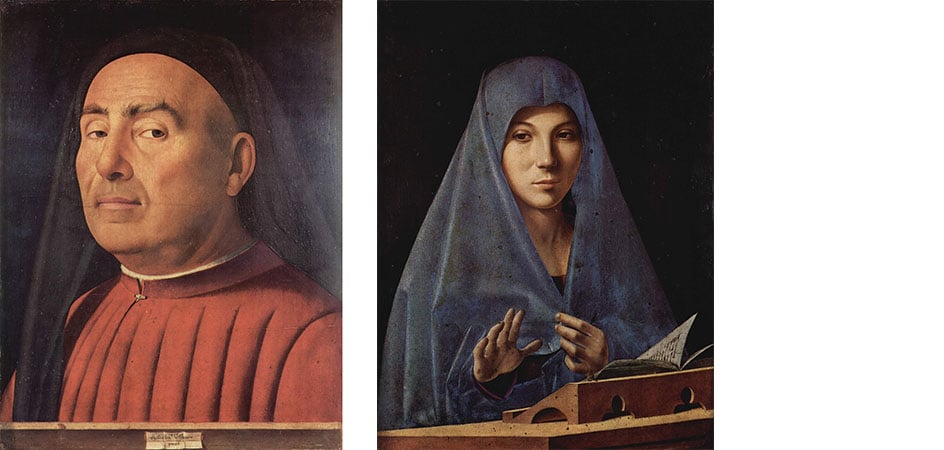
The 1476 Ritratto d’uomo, held at Palazzo Madama in Turin, perfectly brings together Northern realism and the measured sense of space characteristic of Italian art, here expressed through a striking composition viewed from below. The nobleman boldly dominates the panel, looking out at us with a mocking smile. The slightly raised, unruly eyebrow, the barely parted lips, the air of thinly veiled superiority: we cannot help but be captivated by the lifelike quality of his face and clothing, and by the psychological depth of the portrait.
The Annunciata in Palermo, Antonello da Messina’s sublime masterpiece
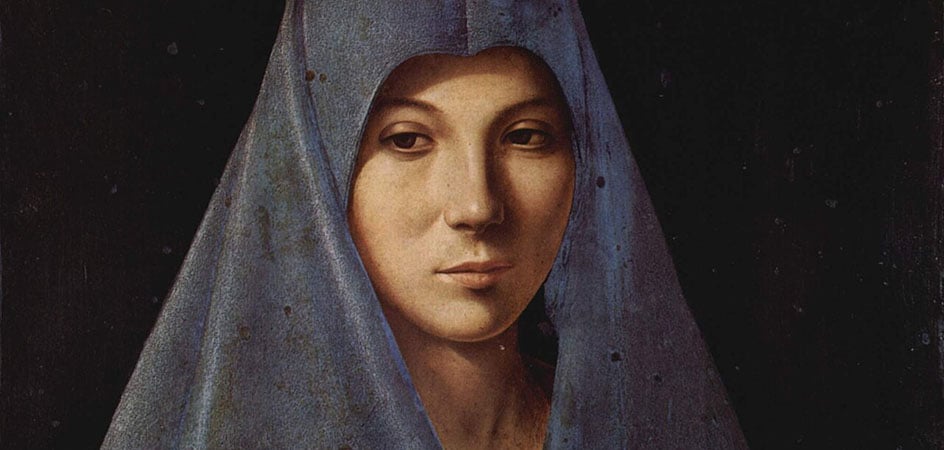
We conclude our journey through the life and works of Antonello da Messina with the Annunciata in Palermo (1475/1476, Galleria Regionale della Sicilia di Palazzo Abatellis), his undisputed masterpiece. Once thought to be a work by Dürer, this Sicilian panel showcases all the qualities of its true creator at their very best. First and foremost is the originality of its composition: the theme of the Annunciation was by no means new at the time, but was generally depicted with both protagonists – Mary and the Archangel Gabriel – clearly visible, often engaged in dialogue. Here, however, the angel is absent, occupying the viewer’s space instead, yet his presence is suggested by a number of carefully considered details: the pages of the sacred book, gently stirred by the movement of air caused by his arrival, and the Virgin’s gesture as she receives both the news and its messenger. Her raised hand, expressing both surprise and acceptance, is one of the painting’s boldest feats of perspective. The effect is heightened by the foreshortened lectern in the foreground – rendered with typically Northern attention to detail – which enhances the sense of depth throughout the composition. Although at first glance Mary appears to be facing us directly, a closer look reveals a slight turn of her body, essential to the spatial construction of the panel. Antonello also uses simple geometric forms to structure the scene: alongside the restrained shapes of the furnishings, the blue mantle – with its curved yet sharply defined outline – forms a clear triangle, while the Virgin’s face is framed within a perfect oval.
Her delicate features, hieratic pose – note the left hand modestly drawing the veil closed – and expression of serene, unshakeable detachment make the Annunciata an icon of the Renaissance.
Elegant, sophisticated and magnetic, the image of Mary receiving the angel itself becomes the bearer of an unmistakable message: the artistic triumph of its creator.
1. Giorgio Vasari (1511–1574), artist, architect and writer at the Medici court, was also the author of Le vite de’ più eccellenti architetti, pittori, et scultori italiani, da Cimabue insino a’ tempi nostri (published in 1550 and expanded in 1568), a foundational text in the history of Italian art.
2. Francesco Squarcione (Padua, 1394/1397–1468) was a Venetian painter and art collector and the teacher – among others – of Andrea Mantegna, the celebrated artist at the Gonzaga court in Mantua.