The history
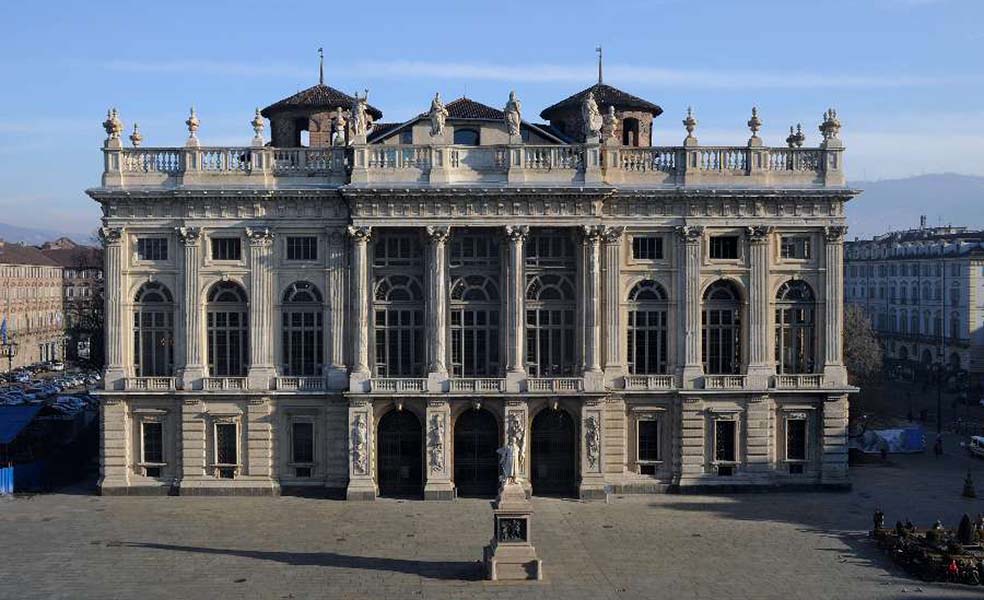
Palazzo Madama is an extraordinary piece of architecture, whose story can still be read today by observing the building’s various structural and decorative elements, continuing through a walk in the Medieval Botanical Garden at the foot of the tower.
This green corner dates back to the medieval period, with the first records from 1402, when expansion work began under Ludovico, Prince of Acaja. Thanks to documents preserved in the State Archives, the garden has been reconstructed in both layout and the selection of plants and herbs described in period treatises.
The palace embodies the entire history of the city: originally a Roman gate, it was transformed in the Middle Ages into a fortress and later into the castle of the Princes of Acaja. Between the 17th and 18th centuries, the Royal Madames of Savoy chose it as their residence, and in the 19th century, King Charles Albert established the first Senate of the Kingdom of Italy there. Since 1934, the palace has housed the Civic Museum’s collections of ancient art.
The collections
Turin’s Museo Civico opened to the public on June 4, 1863, in the building on Via Gaudenzio Ferrari (the Museum later moved to Palazzo Madama in 1933). Initially, the collections were very varied, even though they were all focused on Turin’s history: archeological finds discovered while paving new roads in the city, 19th-century paintings from Piedmont, mementoes from the Risorgimento, collections of Savoy coins. But also testimonies of the “history of handmade objects from Byzantine times to the 18th century”: glass, ceramics, textiles, embroidery, enamels, works in ivory, gold, iron, and leather, furniture, illuminated manuscripts, gems, and cameos. The interest in applied arts from the Middle Ages to the 1700s would then become one of the two driving forces for future acquisitions, while archeological finds, mementoes from the Risorgimento, and 19th-century paintings would gradually be given to other city museums. As the 1800s ended and using the South Kensington Museum of London—opened in 1851—as a model, the Museo Civico would become a museum of arts and industry. An Italian Kunstgewerbemuseum, which shared with other institutions abroad the utopia of influencing the qualitative aspects of coeval artistic artisanry and nascent industrial productions, providing craftsmen and designers with a great number of models of all types and techniques and of great formal quality. In parallel, before the new unified State opened an Office for the Conservation of Monuments (the current-day Superintendence), the Museum focused on saving ancient sculptures from churches and castles across Piedmont and Valle d’Aosta and from the Savoy family from the antiques market and exportation abroad. Starting around 1910 another focus for the Museum became only “regional” painting: early Piedmont painters from the 15th to 16th century and artists associated with the Savoy court between the 1600s and 1700s.
Palazzo Madama, closed for restoration beginning in 1987 for almost twenty years, reopened to the public in December 2006 with a completely renewed museography and still today follows its two-fold vocation that had been defined in the late 1800s: a museum of the city and Piedmont and a museum of decorative arts from all ages and places.
Medieval Botanical Garden
Turin’s Castle Garden was first mentioned in 1402 in documents that record the expenses for upkeep to the building during the reign of Prince Ludovico d’Acaia (1402–1418): these documents mentioning the Garden are the Conti della Vicaria e Clavaria di Torino, the logbooks in which the city’s treasurer, who during the Middle Ages managed the city on behalf of the Princes d’Acaia and then the Dukes of Savoy, recorded the maintenance expenses of the Castle and the city’s fortresses.
The logbooks, today kept at the State Archive of Turin (Sezioni Riunite), cover a span of time from 1402 to 1516. In order to recreate the Garden, the notes contained in these Medieval documents were followed, honoring the traditional division of the space into a hortus (garden), a viridarium (forest and orchard), and an iardinum domini (Prince’s garden), along with traditional furnishings and fittings (for falconry or raising pigs and chickens).
In addition to the plants and vegetation mentioned in these ancient documents, this space also included plants and herbs that were not listed specifically in the documents but were undoubtedly present in Medieval gardens both across Italy and France, based on the information found in treatises on farming and medicinal plants from the 14th and 15th centuries.
The Garden (hortus) Organized according to a checkerboard pattern made up of rectangular flower beds, the Garden is a special space, one visited by the prince during his strolls in the shade of pear and apple trees, and by the Castle gardeners, who tended to the plants used to supply the kitchens with beans, vegetables, herbs, and medicinal herbs. The enclosure served to block the entrance of animals.
The Forest and Orchard (viridarium) From the Latin viridis (verdant), this small wooded area with tall trees was often located outside the Castle walls where pigs, falcons, doves, and mills were found.
In Turin, the area set aside for the forest and orchard was very vast and, at one point, engaged fifty gardeners at the same time. In addition to chestnut, walnut, willow, plum, sorb, cherry, olive, and palm trees—all mentioned in ancient documents—a section of this space was occupied by the Prince’s vineyard, which produced wine for the Castle.
The Prince’s Garden (iardinum domini) This was a private space for the princes, used for reading, conversing, resting, and playing.
In the Middle Ages it was located on the southernmost edge of town, near the walls and Porta Fibellona; it was closed off by walls flanked by blackberry bushes and made from stone with a pergola covered in grapevines. It must have looked like the depictions found on tapestries and miniatures from the 1400s: surrounded by a dense field of millefleurs, it hosted a fountain, often present in courtly literature, brick seating covered in grass and ivy, and a series of majolica vases embellished with scented plants like lavender, sage, and marjoram.
The Princess d’Acaia Bona of Savoy kept a cage with parrots in this section of the garden. The garden lent itself to various social-educational purposes. For Palazzo Madama it was a great opportunity to develop and expand its museum offer, for its itineraries and the possibility to guide learning strategies toward new topics related to the city’s ecology, to the importance of green spaces in community life, to their history, and to current-day issues related to safeguarding them.
Recreating the Medieval garden also means exploring marginal vegetation species, restoring sense and value as regards biodiversity, as well as favoring and promoting projects in collaboration with other city institutions. The project was completed in 2011 thanks to major financial support (1,100,00 euro) by the Fondazione CRT as part of the broader project, “Historic Gardens and Parks.”