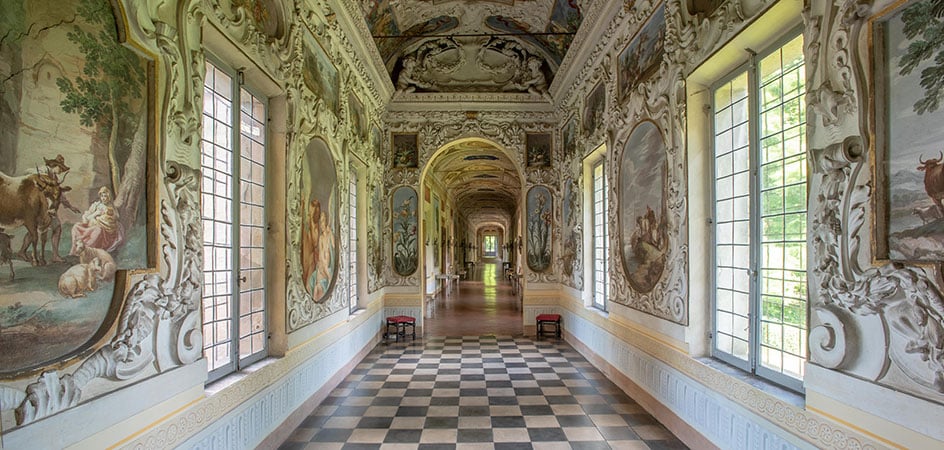


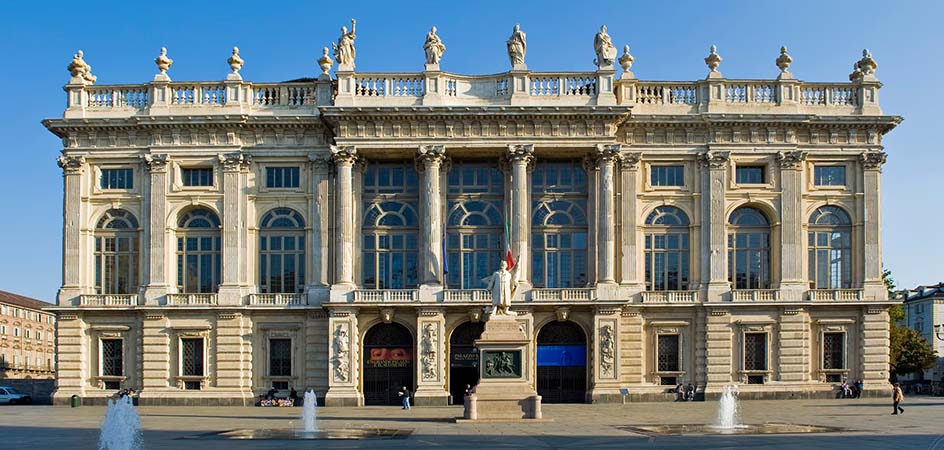
An ancient Roman gate, a medieval fortress, a princely castle and the seat of the first Senate of the Kingdom of Italy: Palazzo Madama in Turin, located in the very central Piazza Castello, has housed the collections of the Museo Civico since 1934. Across four floors, artefacts and works ranging from the Middle Ages to the Baroque period recount the history of art and craftsmanship in the region.
Let’s explore together the rooms of this enchanting museum – one of the most elegant buildings in the city – and take a closer look at some particularly curious and significant objects.
The medieval Lapidarium and the Desana Treasure
Archaeology, as we know, is full of surprises and unexpected twists. This is well demonstrated by many examples, including the François vase, the Greek krater preserved in the Museo Archeologico of Florence. Less adventurous yet equally astonishing is the story of the Desana Treasure, discovered by chance by a farmer in the countryside of Vercelli in the 1930s and now displayed in the medieval Lapidarium on the underground level.
Here, inside the evocative Torre dei Tesori, gold jewellery set with precious stones and finely decorated silver tableware shine once more after centuries of abandonment. But to whom did these refined objects belong, and why were they hidden beneath a thick layer of soil? Historical reconstruction has allowed scholars to identify the original owners: Stefanus, a Roman, and Valatruda, an Ostrogoth – a wealthy mixed couple who lived between the late 5th and early 6th centuries. Within the collection, characterised by artefacts of different styles and origins, two brooches from the 5th century stand out – probably part of Valatruda’s dowry – made of gold with cloisonné enamels and glass paste, a type of craftsmanship typical of northern Europe.
A dowry enjoyed only briefly, since the newly married couple were soon forced to flee due to the looming Gothic War. Before leaving, however, they wisely buried their wealth in the garden of their villa, hoping to retrieve it at a later time. And it is precisely there that they remained until their recent discovery.
The Desana Treasure, therefore, is not only a spectacular testament to medieval craftsmanship – which, despite common prejudice, is in no way inferior to that of the Renaissance – but also the tangible fragment of a human story that would otherwise have been lost.
The ground floor: between Gothic and Renaissance
The visitor route follows a chronological order that continues on the ground floor of the museum, dedicated to the Gothic and Renaissance periods. Spread throughout the various rooms are finely crafted wooden furnishings and sculptures, as well as an important collection of illuminated manuscripts.
Particularly striking is the Bible decorated in 1280 by an anonymous artist from Bologna. It confirms the extraordinary quality and variety of the medievalart of miniature painting, which combines multiple styles and influences. Here, Byzantine-inspired figures intertwine with knightly battles – a legacy of French culture – while the typically Emilian drôleries (bizarre shapes, animals and small genre scenes) enliven the initials and the page margins with measured liveliness.

The collection of paintings from the Piedmontese school is especially rich and documents the development and influences of local painting. The absolute masterpiece on this floor, however, is the Ritratto d’uomo by Antonello da Messina. Painted in 1476 under circumstances that are still not entirely clear, it belongs to the celebrated series of half-length portraits produced by the Sicilian master. A great Italian interpreter ofFlemish realism, Antonello places his figure against an undefined dark background, which highlights the vivid colour of the garment and the complexion of the face, while the headgear blends into the tone-on-tone background. Yet it is the man’s features that inevitably strike the viewer: the details of the face, marked by wrinkles, the mole on the forehead, the millimetric precision of the eyebrows, the complexion rendered with an almost tactile quality and, above all, the expression. The subject – whose identity remains unknown – looks at us with the air of someone who knows more than he lets on, weighing us up with a subtle veil of irony. It is an exquisite demonstration of the Sicilian painter’s ability to render both the psychology of his subjects and the material presence of objects, as seen in the cartiglio (a small painted inscription panel) sealed with wax on the frame bearing the artist’s signature and the date.
The Baroque in the former apartments of the Madame Reali
On the first floor, wooden craftsmanship takes centre stage in numerous forms, ranging from small containers to elaborate pieces of furniture decorated with precious inlays of ivory, rare woods, tortoiseshell and mother-of-pearl. Particularly sumptuous is the kneeler by Pietro Piffetti (around 1750) – cabinetmaker to the Savoy court – who a few years earlier had also created a magnificent wall table (c. 1730–1740). The top, decorated with a mascaron, lions and a large vase, features a curious and recurring motif in the work of this exceptional craftsman: a trompe-l’œil with scattered playing cards, probably derived from a table by the Parisian cabinetmaker Pierre Daneau.

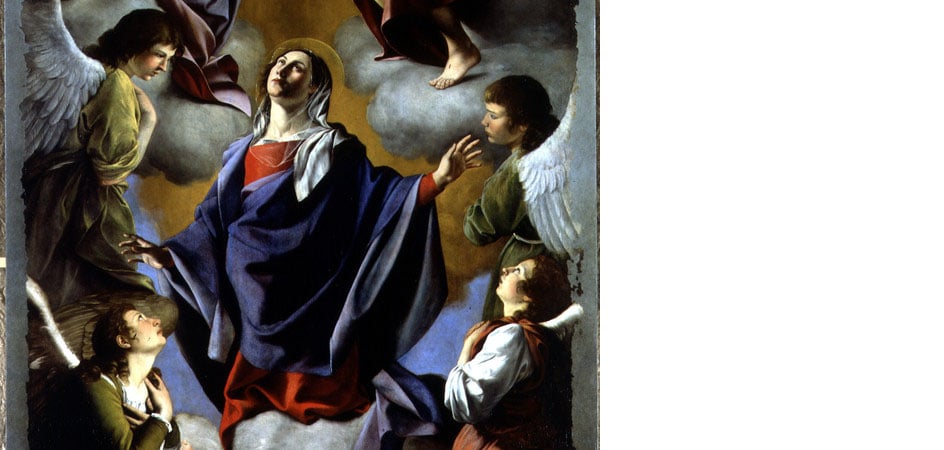
The Baroque picture gallery – arranged in the former residence of the Savoy Madame Reali – displays a rich selection of Caravaggesque works, including two paintings by Orazio Gentileschi, the Assunta (1605–1608) and San Girolamo (1610–1611). The latter is the second version of a subject previously painted by the Roman artist, for which he used the same model: the seventy-three-year-old Giovanni Pietro Molli.
Molli frequently posed for Gentileschi and was even called to testify in the trial for sexual violence involving the painter’s daughter Artemisia Gentileschi and the accused Agostino Tassi. Beyond these historical circumstances, what we see today is a painting of great emotional impact, heightened by the light falling from above and illuminating the body, garments and the saint’s typical iconographic attributes, all rendered with remarkable precision.
Decorative arts: ceramics, glass, rare textiles
Palazzo Madama offers an extraordinary number of works to admire for anyone passionate about decorative arts. The second and top floor houses some of the most important collections in Italy, including the ceramics collection. There are more than four thousand pieces – largely linked to the activities of the diplomat and collector Emanuele Taparelli d’Azeglio – varying in period, style and function. Many examples stand out, such as the animals from Meissen (1735), named after their place of production, and the Medici porcelain jug (around 1575), the largest surviving example of this manufacture.
D’Azeglio was also responsible for assembling the extremely rare and precious nucleus of more than two hundred works in painted glass and gold-engraved glass. These join the extensive collection of archaeological, medieval and Renaissance glass and enamels displayed in the so-called Camera di vetro.
Finally, we must not overlook the textiles, also collected thanks to d’Azeglio’s foresight, and the precious collection of velvets worthy of the most renowned museums north of the Alps.
A dual purpose guided the museum’s 19th-century choices and acquisitions: on the one hand, the desire to establish itself as a guardian of local history; on the other, the ambition to become a source of models for contemporary industry and craftsmanship, following the example of institutions such as the South Kensington Museum in London, the predecessor of today’s V&A.

The Botanical Garden: an immersion in the medieval hortus
Before leaving this treasure chest of ancient works and knowledge, we strongly recommend a stroll through the wonderful medieval Botanical Garden. Reconstructed in 2011 on the basis of historical documents, it is a truly magical place not only because it unexpectedly lies in the very centre of the city, but also for the variety of species it hosts.
The garden is organised into a vegetable garden (hortus), woodland and orchard (viridarium), and the prince’s garden (iardinum domini). Roses, hellebores, textile and dye plants, aromatic and medicinal herbs, fruits and vegetables populate this “museum within the museum”, offering visitors a unique experience of colours, fragrances and forms.
Palazzo Madama, with its spacious rooms, thematic floors, extraordinary collections of artworks and artefacts, and its unexpected garden, is an inexhaustible source of knowledge and beauty. Not to be missed!