

Few objects in the world test a designer’s abilities quite like the domestic chair. It must support the human body, occupy just the right amount of space, be suitable for mass production without losing its formal identity, and withstand changing fashions over time. We have selected seven chairs that have passed this test with flying colours. They have found their way into our homes, museums and popular culture and, in many cases, are still being manufactured today with virtually no significant changes to their original design.
1. N. 14 by Michael Thonet, 1859
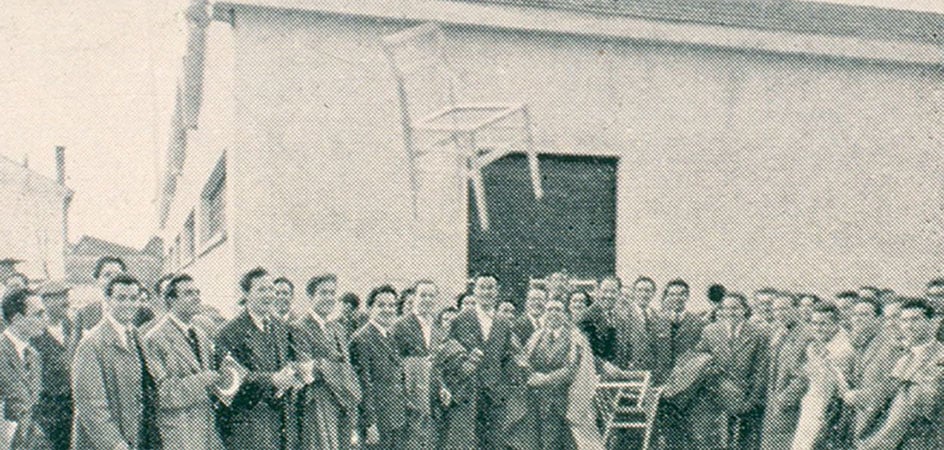
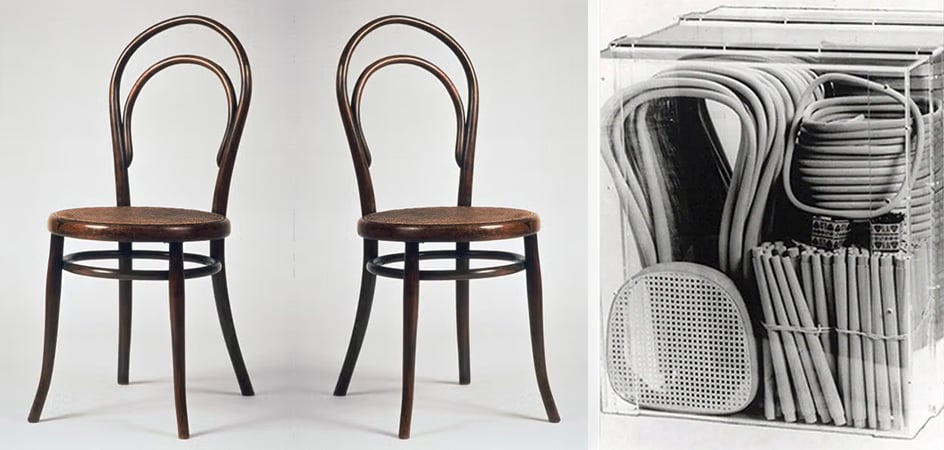
An unsurpassed classic, the N. 14 is regarded by many as the chair par excellence, a successful synthesis of aesthetics, practicality and manufacturing requirements. In 1841, the Prussian cabinetmaker Michael Thonet (1796–1871) patented the mechanised process that enabled him to bend wood into shape and permanently retain its form. The technique was perfected through twenty years of experimentation and trial, becoming immortal through his creations, which have since been widely reinterpreted and copied. His name is primarily associated with chairs and, above all, with the N. 14, introduced in 1859 and still in production today. From that moment onwards, the story of a simple craftsman became that of a highly successful industrial enterprise capable of producing more than 4,000 chairs a day.
Only six components are needed to assemble it: solid beechwood elements bent with steam and immersed in a solution of water and glue to fix their shape, an extended backrest that merges seamlessly into the rear legs, and a seat woven in Vienna cane or made from solid wood. Its lines are clean and essential, completely free of hand-crafted ornamentation. This simplicity is one of the secrets of its beauty, while also offering numerous practical advantages: it is easy to manufacture, occupies very little space when disassembled, and is straightforward to pack and ship. Today it can be found in homes and bistros across the world, regardless of style, an unmistakable and enduring design icon.
2. Plastic Side Chair Dsw by Charles and Ray Eames, 1950
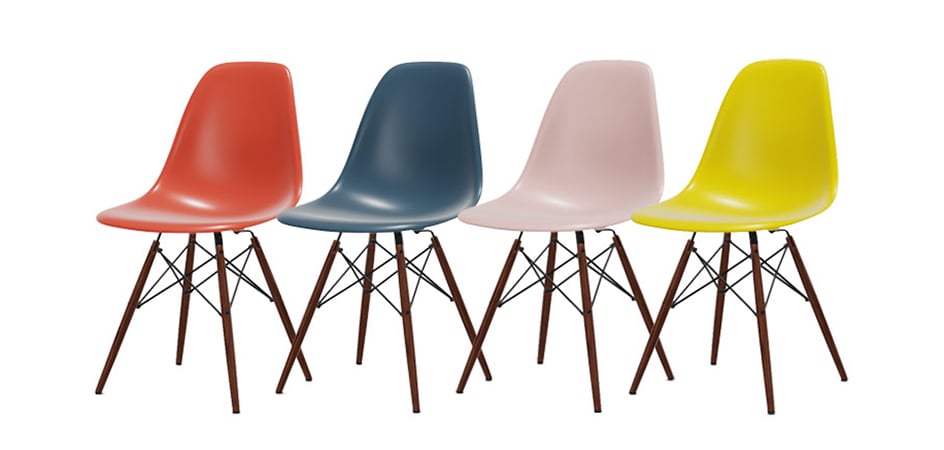
The Plastic Side Chair – DSW by Charles (1907–1978) and Ray (1912–1988) Eames—partners both in life and in work—has been copied countless times. More than a single chair, it is in fact an entire family of designs developed from the same brilliant concept. Today the idea may seem obvious, but in the 1950s, when it was first produced by Vitra, it was revolutionary: using plastic to create a single-piece shell that perfectly follows the contours of the human body. For years, the Eameses had been searching for the ideal material to produce a chair that was affordable, accessible and yet beautifully made. They eventually found it in a combination of polyester resin and fibreglass—a material that was inexpensive, malleable, pleasant to the touch and suitable for industrial production. Its versatility was further enhanced by its configuration. The seat could be paired with different bases, featuring either wooden legs or steel frames with or without cross-bracing, allowing it to suit virtually any function or setting.
Presented in 1949 at the MoMa’s “Low-Cost Furniture Design” competition in New York, the Plastic Chair collection was officially launched the following year. They became the first industrially manufactured chairs made from synthetic material. Since then, they have never ceased to win over the public thanks to their distinctive shapes and colours and to the designers’ constant pursuit of innovative solutions, including the use of post-consumer recycled plastic in the most recent models.
3. CH24 (Wishbone Chair) by Hans J. Wegner, 1950
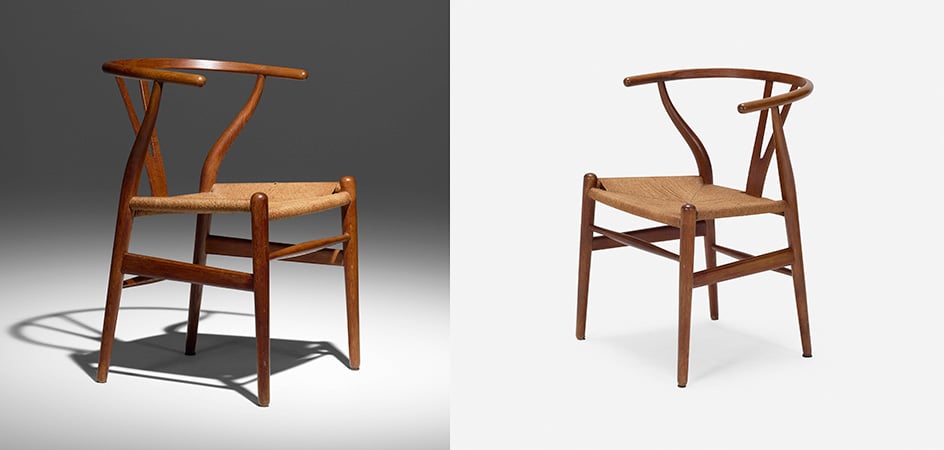
Produced continuously since 1950, the CH24 is one of the most recognisable creations of Carl Hansen & Søn and of its designer, Hans J. Wegner (1914–2007), widely regarded as the master of Danish design. There are many reasons behind this reputation, and the CH24, also known as the Wishbone Chair, embodies them all. First and foremost is its use of wood, a material long cherished by both the designer—a cabinetmaker by trade—and the company. Then come its graceful, flowing curves, achieved through steam bending, and above all its construction technique, which continues to pose a considerable challenge for mass production. Even today, more than one hundred manual operations are required to produce each chair, including the weaving of the seat. This process alone takes over an hour and still follows the characteristic envelope pattern using paper cord—a humble material chosen in the post-war years due to the shortage of more precious alternatives. (In this respect, one cannot help but notice certain similarities with the story of Salvatore Ferragamo, a designer working in a very different field but displaying comparable ingenuity and international acclaim). The chair is a tribute to craftsmanship and the care of traditional woodworking, defying the logic and conventions of modern industrial production. Inspired by the historic thrones of Japanese emperors, the Wishbone Chair owes its nickname to the distinctive Y-shaped backrest, which resembles either a wishbone or a bird’s clavicle. Throughout his career, Wegner designed more than 500 chairs, yet this one—with its completely original silhouette—has become the design that represents his signature more than any other.
4. 699 Superleggera by Gio Ponti, 1957
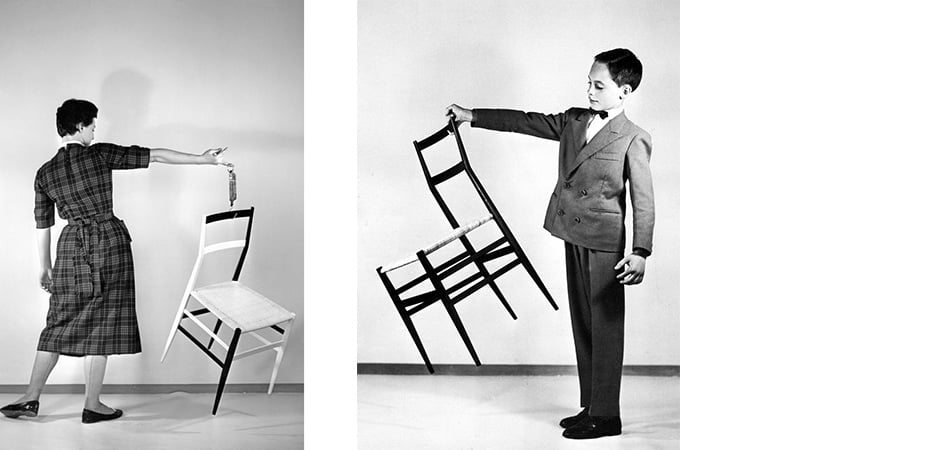
No imaginary museum of the finest designer chairs ever created would be complete without the 699 Superleggera by Gio Ponti (1891–1979) for Cassina. It is called Super because it followed the Leggera, designed a few years earlier by the celebrated Milanese architect and designer. And super light it truly is, weighing just 1.7 kilograms! Its extraordinary lightness is the result of meticulous attention to every detail, combining outstanding craftsmanship with the demands of industrial production. A perfect example is the refined triangular cross-section of the legs, which reduces the chair’s overall weight with remarkable elegance.
Its elegance is further enhanced by the subtle backward inclination of the backrest, giving the chair a delicate sense of movement—a playful touch within an otherwise restrained design. Its distinctly contemporary appearance contrasts with the seat, woven from fine Indian cane, an explicit reference to the traditional vernacular chairs that inspired Gio Ponti: the so-called Chiavarine, named after the Ligurian town of Chiavari, where they originated.
Light as air yet remarkably strong, the 699 Superleggera transforms tradition into an enduring example of modern harmony.
5. Tulip by Eero Saarinen, 1956
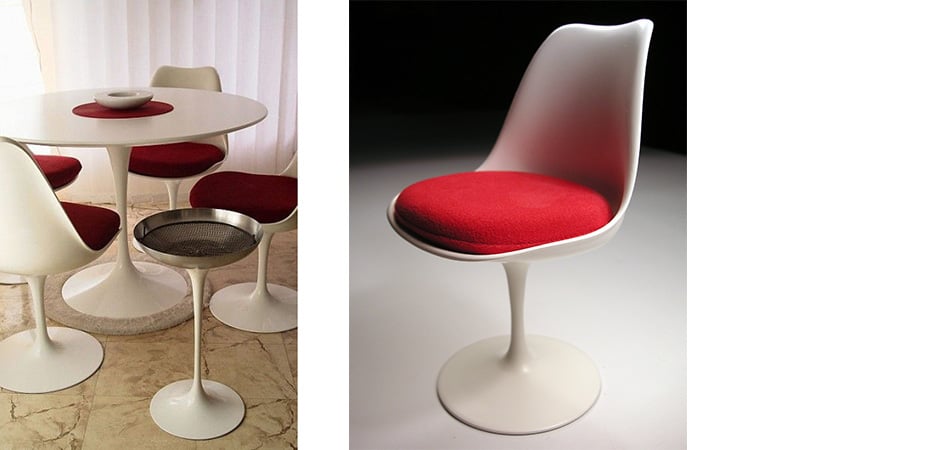
With the eye of an architect and the training of a sculptor, Eero Saarinen (1910–1961) set out in 1956 to solve the long-standing problem of the tangle of legs typically found beneath tables and chairs supported by four legs. The result was the Pedestal Collection, which includes Tulip, the chair featuring a single coated aluminium pedestal base, a moulded plastic seat and a removable cushion. The collection also included a table and an armchair built around the same clean, unified structure, creating a visual harmony that brings order and clarity to any interior. To develop the design, Saarinen produced hundreds of sketches and scale models, even constructing a miniature room the size of a doll’s house.
This allowed him to observe the overall composition and ensure that Tulip would exist in complete harmony with its surroundings. True to his rigorous approach, before launching the furniture for Knoll International, Saarinen tested it himself. The earliest prototypes were placed throughout his American home, where friends and family were invited to use them and provide feedback.
Its innovative form, structure and proportions established Tulip as a genuine design icon and one of the crowning achievements in the career of this giant of twentieth-century design.
6. Panton Chair by Verner Panton, 1967
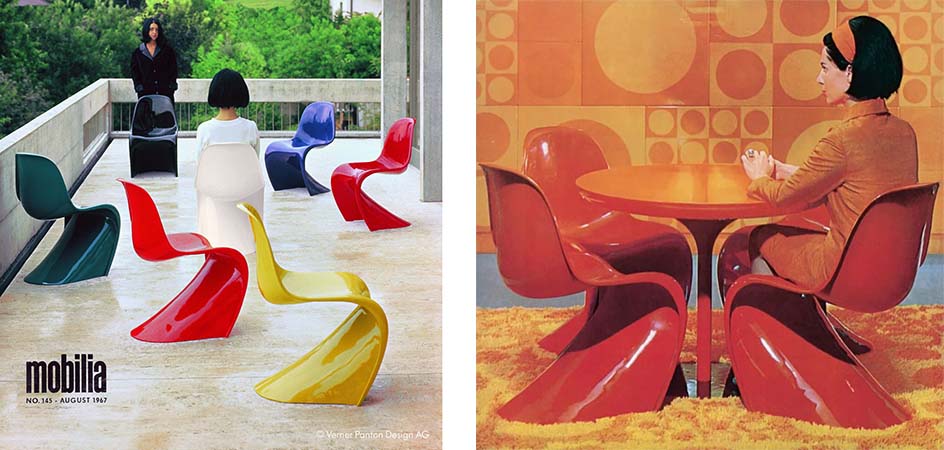
“Most people spend their lives living in a dreary grey-beige conformity, with a mortal fear of using colour.” These are the words of Verner Panton (1926–1998), the Danish-born designer who later became a Swiss citizen and transformed the world of furniture with his colours and daring geometric forms. Among his most celebrated creations is the legendary Panton Chair, conceived in the early 1960s but not produced by Vitra until almost a decade later. It perfectly embodies the revolutionary and unconventional spirit of its time. It was the world’s first one-piece plastic chair to be manufactured industrially from synthetic material—a material that has evolved over the years to become stronger, more durable and more economical—available in bright, vibrant colours. Its organic silhouette, so different from that of traditional chairs, immediately captures the eye while perfectly accommodating the contours of the human body. On closer inspection, the design follows the same principle as another historic seat, the S33 by Martin Stam (1899–1986), a cantilever chair with a flowing curved profile. Yet the final result could hardly be more different—or more playful. A single piece of polypropylene bends seamlessly to create the backrest, seat and base, eliminating the need for conventional legs altogether.
7. Silver by Vico Magistretti, 1989
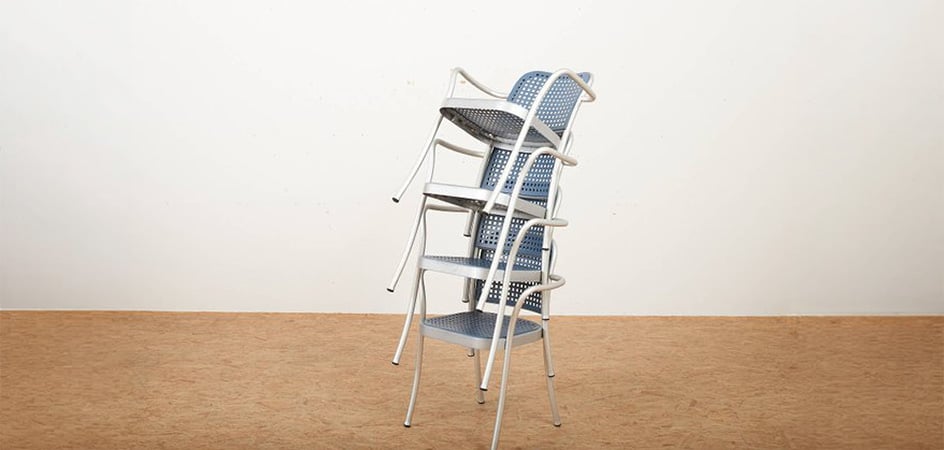
Positioned somewhere between N. 14 by Thonet and the Cesca by Marcel Breuer (1902–1981), Silver by Vico Magistretti (1920–2006) perfectly expresses the design philosophy of the Milanese architect and designer. For Magistretti, the simplicity of everyday objects was almost a creed, as was functionality free from unnecessary embellishment. Silver features an essential design reduced to its most indispensable elements, yet without sacrificing beauty—quite the opposite. It is precisely this pure, minimalist aesthetic—with traditional forms and materials reinterpreted in a contemporary way—that continues to make it feel relevant today. Instead of bent beechwood, Magistretti chose aluminium or steel tubing; instead of woven straw, perforated plastic. That distinctive square perforation was reportedly inspired by Japanese egg baskets that Magistretti had noticed at a market in Tokyo—yet another demonstration of how everyday life and the humblest of objects constantly fuelled his powers of observation and creativity.
Introduced into production by De Padova in 1989 and manufactured continuously ever since, Silver shows no sign of its age. Its timeless aesthetic blends effortlessly into both classical and contemporary interiors, whether formal or informal, and has evolved into a complete seating system available with or without armrests, swivel versions on castors, stackable models and bench configurations.
Design enthusiasts will forgive us for this necessarily selective list, fully aware that many other iconic chairs could easily have been included. Nevertheless, it provides an excellent starting point for anyone wishing to explore this fascinating world, where the simple act of sitting transcends mere function to become an expression of design, craftsmanship and technical innovation.