

It is always the face that we look towards, in life as in art, when we question a subject’s identity and attempt to interpret their emotions and thoughts. But what happens when this window is denied to us? What if the person shows us their back? What cannot be seen attracts our attention, and its symbolic and poetic value captivates us. From the Roman age to contemporary art, let us explore together some of the most iconic figures seen from behind and allow ourselves to be seduced by this unusual perspective.
Figures seen from behind in Western Art
Codified as Rückenfiguren (“figures seen from behind”) by nineteenth-century German Romanticism, figures shown from the back had appeared in Western painting long before. One of the earliest examples is the frescoed Flora or Primavera from the 1st century AD, discovered during excavations of the ancient city of Stabiae and now housed in the National Archaeological Museum of Naples. The goddess, intent on gathering flowers, appears so absorbed in her activity that she forgets to turn around, the only figure in the entire decorative scheme not to look towards the viewer.
In the Middle Ages, figures shown from behind, often included in crowded scenes, are rare and serve various purposes: creating perspectival depth; emphasising the contrast between “good” characters – shown frontally – and “bad” ones – shown from behind, with a clear symbolic significance; simply balancing the composition; or inviting the viewer to enter the narrative of the painting. Among the finest examples of the use of this motif is Giotto, particularly in Il Compianto sul Cristo morto (1303–1305) in the Cappella degli Scrovegni in Padua. The women seated on the ground in the foreground, of whom we see only their backs, are not merely a device to simulate three-dimensionality but invite us to participate physically and emotionally in the scene: their posture, with their bodies turned towards the focal point of the painting, recalls that of the audience itself, which is likewise witnessing the tragedy.
The Magdalene in Masaccio’s Crocifissione (1426, Naples, Museo nazionale di Capodimonte) is depicted in an exasperated gesture of deep and heartrending sorrow. By denying us her face and the grimace distorted by suffering, the rear-facing pose with hands raised towards the sky – so different from the more composed attitudes of Mary and Saint John on either side of the Cross – heightens the power of the emotion and makes it unmistakable.
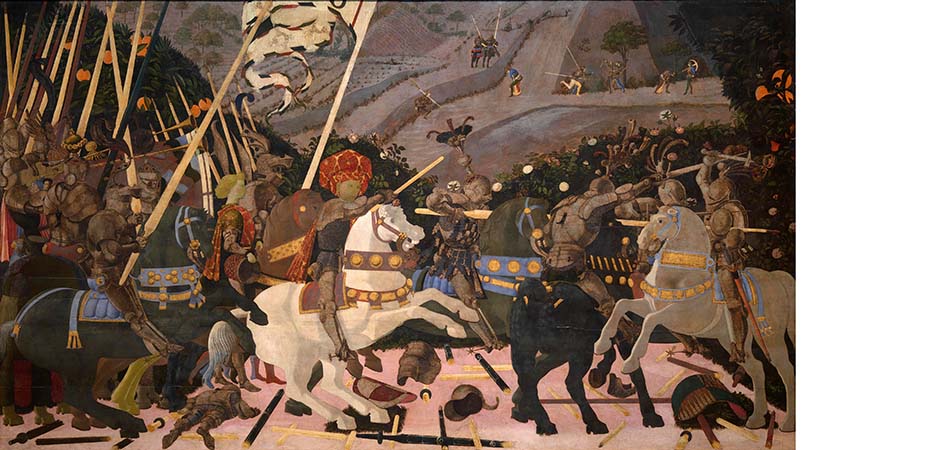
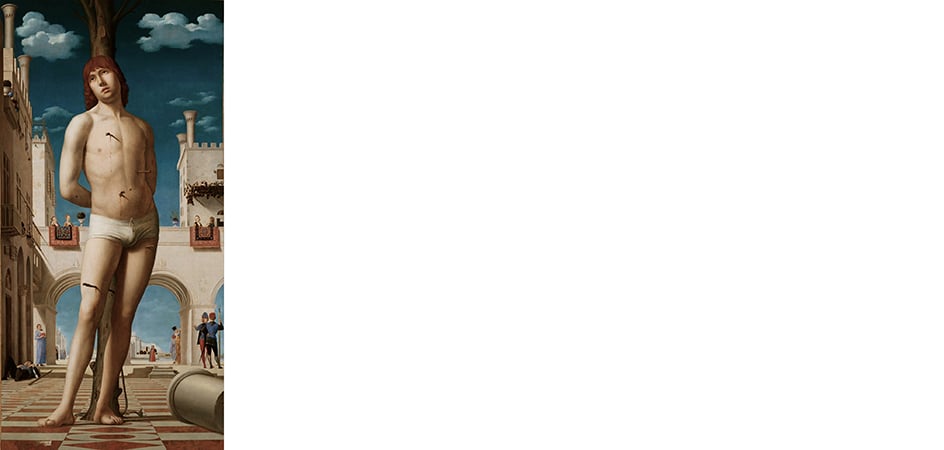
There is certainly no shortage of Renaissance examples: among others, we may think of the London panel of Battaglia di San Romano by Paolo Uccello (c. 1438–1440), where the dead soldier serves to emphasise the perspectival foreshortening and the mounted warrior adds dynamism to the scene. We may also think of Antonello da Messina, with his San Sebastiano (c. 1478–1479, Dresden, Gemäldegalerie), and the indifference of the two noblemen conversing in the background, a perfect counterpoint to the saint’s frontal pose.
Figures seen from behind in Italian painting of this period are often villains, executioners, thieves and other despicable characters, used precisely to highlight the moral worth of the figure opposed to them. When nude, however, they become a tool for studying anatomy (who could forget Michelangelo’s sketches?) before establishing themselves as subjects in their own right, no longer mere supporting figures, with a strong erotic connotation.
Different solutions emerged in the Flemish territories where, from the fifteenth century onwards and with increasing momentum during the seventeenth century, figures represented from behind became progressively more widespread. The intention was largely descriptive: in an increasingly bourgeois society, painting – always attentive to reality – exploited turned silhouettes to tell us about the habits and behaviours of ordinary people.
It was the nineteenth century, however, that fully embraced this iconographic motif and adopted it as a symbol of Romantic aspirations and inner turmoil, establishing a tradition for subsequent artists.
Faceless: 5 works that turn their backs on us
Engaging, sensual and paradoxical: when the figure seen from behind ceases to be secondary and becomes the main subject of the work, it releases all its allegorical power and mystery, enough to ignite our curiosity and imagination.
1. Venere allo specchio by Diego Velázquez
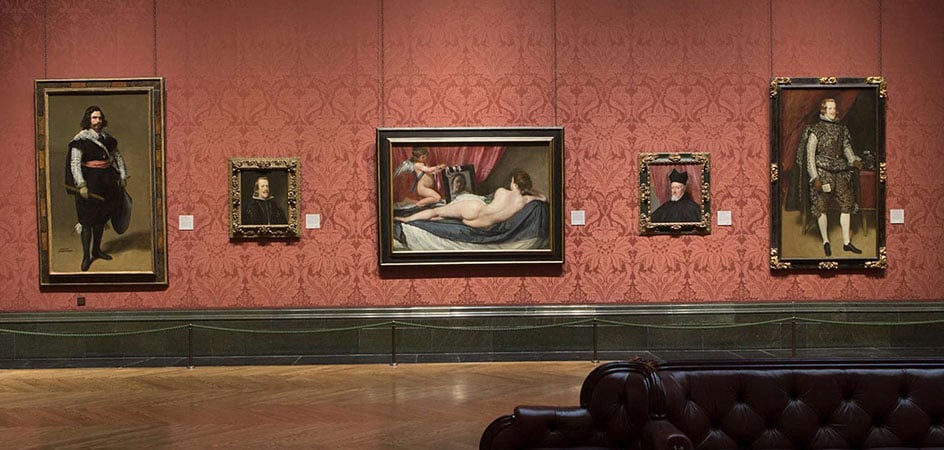
One of the most famous nudes in the history of art and the only surviving nude by the Spanish artist, Venere allo specchio (1647–1651, London, National Gallery) bears witness to his remarkable originality and mastery. Reclining on her right side, completely nude, a voluptuous Aphrodite presents her back to the viewer while Cupid holds up a mirror for her to gaze into. The curve of her hip, the roundness of her buttocks, the pearly tone of her skin: Velázquez depicts the female body by emphasising the sensual charge of its forms, the true focal point of the painting. The reflection of her face appears less distinct. Its contours are blurred, making it impossible to identify the model. This is thought to be a deliberate choice – like the almost unfinished treatment of Cupid’s rear leg – intended to focus all attention on Venus’s nudity. The theme of Venus was certainly not new, and Velázquez was probably familiar with the precedents of Tiziano and Giorgione. Yet in a stroke of genius, instead of offering the figure frontally to our voyeurism, he surprises us with an equally effective rear view, languidly reclining among soft and seductive sheets.
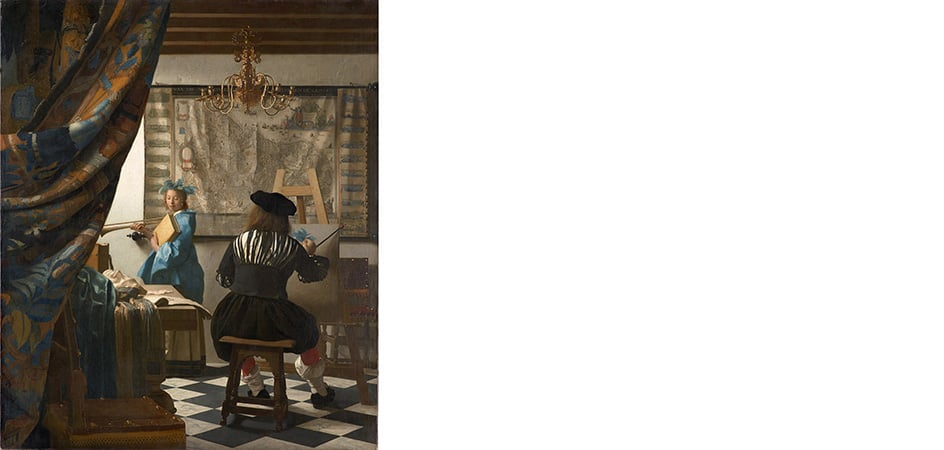
2. Allegoria della Pittura by Vermeer
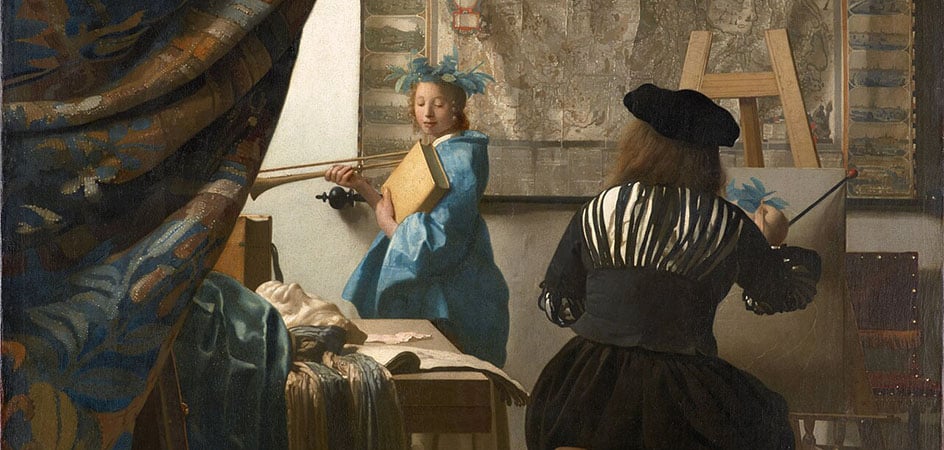
A painting that appears explicit at first glance yet is deeply mysterious in reality. Johannes Vermeer van Delft created it between 1666 and 1668, but we do not know for whom it was painted nor its intended narrative purpose. There is no unanimous interpretation, although the reading inspired by its title, Allegoria della Pittura (Vienna, Kunsthistorisches Museum), is generally accepted. In an elegant interior, a man seen from behind, dressed in refined clothing, paints a young model in the guise of Clio, the Muse of History.
Her identity is revealed through her attributes: the book, symbolising historiography; the trumpet, alluding to fame; and the laurel wreath, recalling glory. In the background, a geographical map – a reproduction of a real map – depicts the Seventeen Provinces, the name by which the Netherlands were known until 1581. The painting may therefore celebrate art inspired by history, or art that earns a place in history and brings renown to the artist’s homeland. But who, we ask, is the artist? We are inclined to believe it is Vermeer himself who, seemingly supporting this theory, signs the map with his initials. Yet there is no conclusive evidence, and this mystery makes the work all the more intriguing. Is it perhaps a meta-commentary on painting, revealing that all art is illusion despite the supposed realism of representation? The theatricality of the scene is undeniable, with the foreground drapery pulled aside like a stage curtain, a place of convincing yet ultimately fictional performances. It is precisely this curtain that introduces us to the intimate and seemingly casual moment of the painter portraying his model, transforming the scene into a discovery rich in symbolic significance.
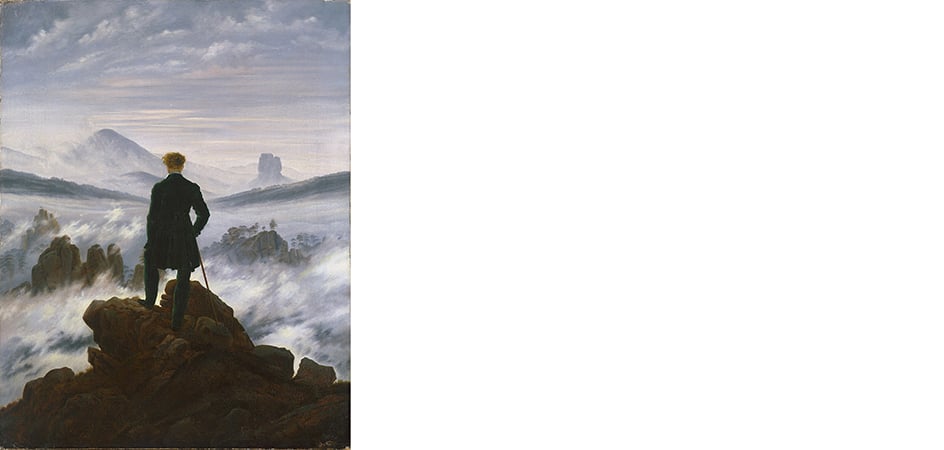
3. Viandante sul mare di nebbia by Caspar David Friedrich
Considered the manifesto of Romanticism, Viandante sul mare di nebbia by Caspar David Friedrich (1818, Kunsthalle, Hamburg) is the perfect representation of the Rückenfigur. A gentleman, dressed in a frock coat and carrying a walking stick, stands atop a rocky mountain peak. His identity is concealed by his pose, although some scholars believe he may represent a deceased Saxon infantry colonel who was a friend of the painter. Ultimately, who this man really was matters little, because what counts here is what he symbolises. Exposed to the grandeur of the landscape, his hair tousled by the wind, he loses himself in contemplation of the natural spectacle unfolding before him – and before us. The barren and magnetic landscape, almost lunar yet real (Friedrich was renowned for his ability to reproduce the Bohemian countryside faithfully), provides a majestic counterpoint to the human figure, so shadowy and almost powerless in comparison despite occupying a prominent position. The irresistible yet intimidating fascination of the scene perfectly conveys that mixture of terror and wonder that constitutes the sublime theorised by the German Romantics. The true subject of the painting is therefore not merely the man seen from behind, but the man seen from behind immersed in this specific context, an expression of his own state of mind, a misty yet substantial mirror of his inner feelings. For this exchange between inner and outer worlds, between interiority and external reality, this is undoubtedly one of the most famous figures seen from behind of all time.
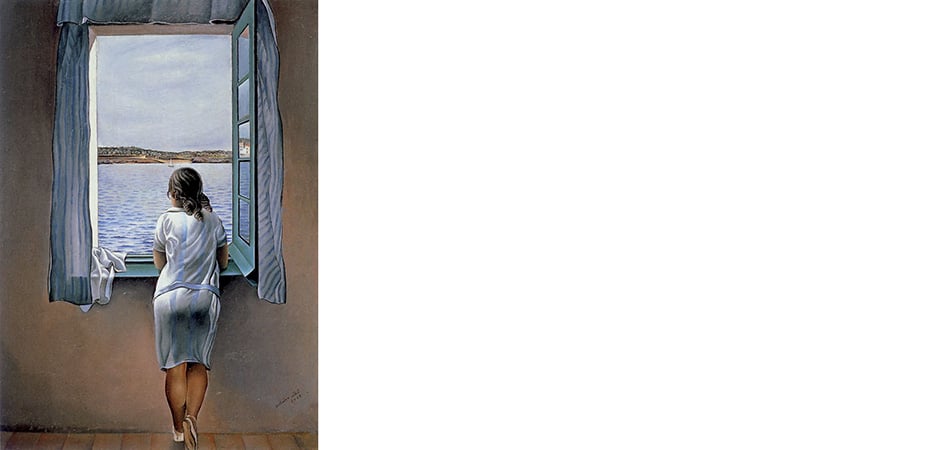
4. Figura alla finestra by Dalì
Unlike the previous examples, we know exactly who the protagonist of Figura alla finestra (1925) by Salvador Dalì is. Preserved at the Museo Nacional Centro de Arte Reina Sofía in Madrid, the painting portrays Anna Maria, the artist’s sister, whom he depicted many times during their stay in Cadaqués. The young woman turns her back to us and, from a sparse domestic interior, gazes out of a window towards the bay. What she is thinking and what emotional state she is experiencing can only be imagined, as nothing of her expression is revealed. The cool palette of the painting – dominated by browns, greys and blues – contributes to its melancholy and reflective atmosphere. The work owes much to the stylistic explorations of Cubism and Realism that Dalì was undertaking during these years, before embracing the Surrealism for which he would become famous. The influences, however, are not only compositional. The maritime horizon observed by the young woman is almost a direct quotation of the watery background in Andrea Mantegna’s Morte della Vergine (1462), which Dalì had studied at the Museo del Prado and which appears in a similar form in his portrait of Luis Buñuel (1924, Madrid, Reina Sofía).
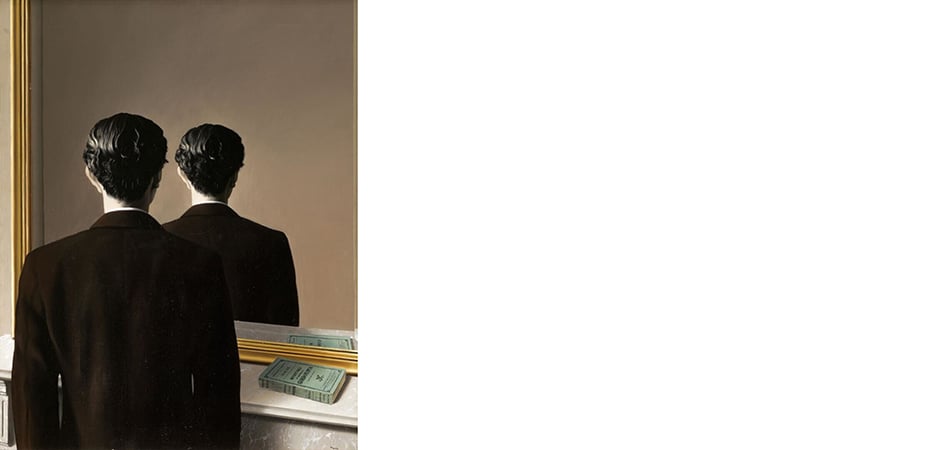
5. La riproduzione vietata by René Magritte
We conclude this brief journey through the history of figures seen from behind with another mirror that, like Velázquez’s, refuses to perform its expected function. This time the artist is the Belgian René Magritte, who portrays his friend and patron Edward James standing before a mirror. Yet, contrary to what should happen, in La riproduzione vietata (1937, Rotterdam, Museum Boijmans Van Beuningen) we do not see the subject’s face reflected, but once again his back. The resulting double image is profoundly unsettling, particularly because, unlike the man, the book resting on the mantelpiece is reflected perfectly. It is an ironic and disturbing touch that fits seamlessly within Magritte’s artistic practice, whose Surrealism drew inspiration not from dreams or imagination but from everyday objects viewed in bizarre and unexpected ways – surreal, precisely. Here it is the subject himself who appears “bewildered” (and we along with him!), in a game of reversed reflections that denies us the revelation of his frontal image. The effect is amplified by the very genesis of the painting, which Magritte created based on a photograph he himself took of Edward James while he was looking at his painting Sulla soglia della libertà.
Difficult to decipher yet magnetic, figures seen from behind have traversed the history of Western art, carrying upon their shoulders a multitude of meanings and interpretations that continue to intrigue us to this day.