

It is said that Raphael was a skilled seducer and that Bernini once tried to kill his brother in a fit of jealousy after discovering his relationship with his lover, Costanza Bonarelli. It seems that Manet and Degas were in love with the same woman, which may have contributed to the tension between them. The lively romantic life of Pablo Picasso is well known.
Love has always been an essential part of artists’ lives and work. But what happens when romantic partnership intertwines with professional collaboration? Sometimes masterpieces are born, sometimes sparks fly. Let us explore the stories of five famous couples in 20th-century art.
Frida and Diego: “the dove and the elephant”
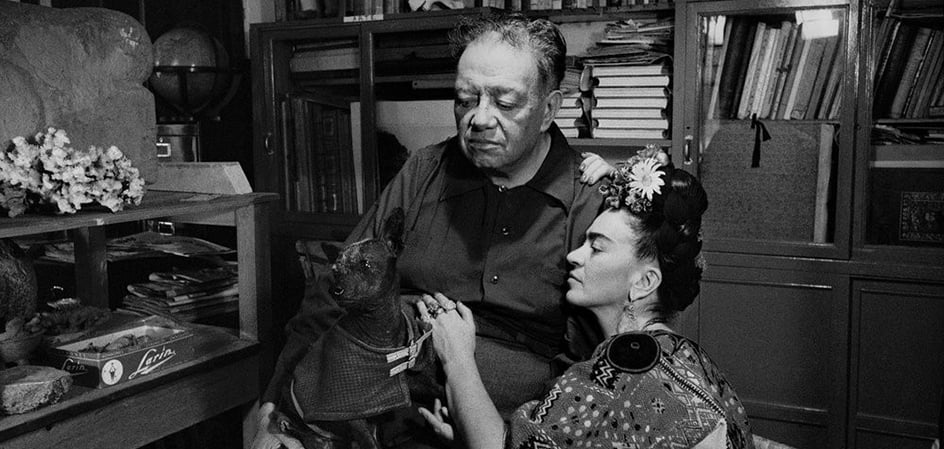
It is 1929 when Frida Kahlo (1907–1954) and Diego Rivera (1886–1957) get married. She is a 22-year-old student recovering from a terrible accident that forces her into multiple surgeries and long periods confined to bed in severe pain; he is 43 and an established artist, an active member of the Mexican Communist Party, to which she also belongs. On their wedding day, the bride’s father compares their union to that of a dove and an elephant.
Visually, they could not be more different, yet their shared political ideals, interest in local traditions, and desire to create “art for the people” bring them together. Their artistic language, however, is radically different: Diego’s murals are monumental and provocative, gaining international success in the early years of their marriage, while Frida’s paintings are small, intimate and full of emotion, and would not receive recognition until 1938, the year of her first exhibition. Their love is intense, deep and visceral, yet also unhealthy, marked by suffering and mutual infidelity. Frida’s lifelong pain—caused by repeated miscarriages and her inability to become a mother—is reflected in her iconic and striking Ospedale Henry Ford or Il letto volante (1932, Mexico City, Dolores Olmedo Collection). Pain that resurfaces when the artist suffers yet another betrayal by her husband—the worst of all, with her sister Cristina. They separate, only to remarry two years later. Tormented yet unbreakable, theirs remains one of the most famous and talked-about relationships of the 20th century.
Jean and Niki: a perfect machine
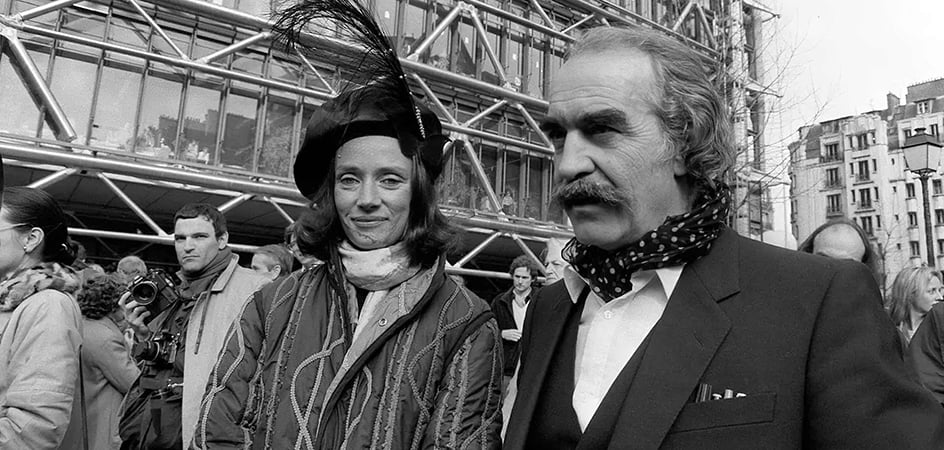
Eternal—and immortalised through their shared creations—the love between Jean Tinguely (1925–1991), a rebellious Swiss artist, and Niki de Saint Phalle (1930–2002) a model, painter and sculptor of Franco-American origins. They meet in Jean’s studio in 1955, when Niki visits him and, observing his mechanical sculptures, remarks: “You could put feathers in your contraptions.” Their relationship begins five years later, when she finds the courage to leave her husband and children to follow both her great love and her artistic ambition.
A dream that Tinguely immediately supports and helps to bring to life: theirs is not only a romantic liaison, but a true working collaboration. Striking and always unconventional, Jean and Niki bring excitement and disruption wherever they go, fearless interpreters of the rebellious spirit of the 1960s. Among their most unforgettable works is Hon, an immense reclining female figure created in 1966 for a temporary exhibition at the Moderna Museet in Stockholm. Its appearance is similar to that of the Nana, Niki’s brightly coloured female sculptures, but the engineering behind this imposing sculptural architecture is Tinguely’s achievement. The scandal is evident: Hon—a word which in Japanese means “origin”—is entered through a large vaginal opening.
Though their paths eventually diverge, their bond remains unbreakable, and Niki stays by Tinguely’s side until his death.
Marina and Ulay: when art becomes the body
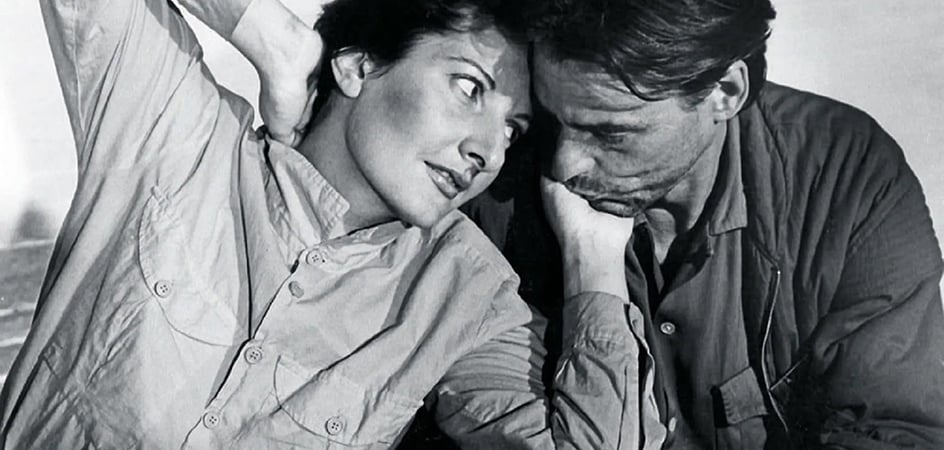
Separated and reunited, Marina Abramović (1946) and Ulay—the stage name of Frank Uwe Laysiepen (1943–2020)—are leading figures in 1970s Body Art and an inseparable couple for twelve years, both love and work. Their career begins on an important stage: the XXXVII Venice Biennale in 1976, where Marina—invited as an artist—chooses to share the stage with her new partner. The two are naked inside an abandoned building; they run towards each other, collide, then separate, only to begin again with ever-increasing intensity: the performance is titled Relation in Space.
Their connection is complete and can also be felt in their later works. After their Venetian experience, Italy hosts another major success by this iconic couple: the performance Imponderabilia, staged a year later at the Galleria d’Arte Moderna in Bologna. Once again naked, Marina and Ulay stand facing each other on either side of the already narrow entrance to the museum. To enter, visitors must turn sideways and brush against their bodies, their faces, their gaze, deciding in a matter of seconds whether to face Ulay or Marina.
As might be expected, alongside the intensity of their relationship and the energy of their performances, the first tensions begin to surface. One of the most striking occurs during Nightsea Crossing, when Ulay—suffering from the prolonged fasting imposed by the performance—decides to interrupt it, while Marina continues alone. It is through a performance (The Lovers: The Great Wall Walk) that the two say goodbye: in 1988 they walk the Great Wall of China from opposite ends, each covering over two thousand kilometres, until they meet halfway and bid each other farewell—almost forever. Their love, once so tangible and manifest, has by then run its course, yet it continues to live on in their work.
The final act unfolds in 2010 when, during the performance The Artist is Present at MoMA in New York, Ulay and Marina meet once again face to face, and Marina melts into a gesture of affection—public yet sincere: for a long moment, they are united once more.
“The Christos”: a monumental love
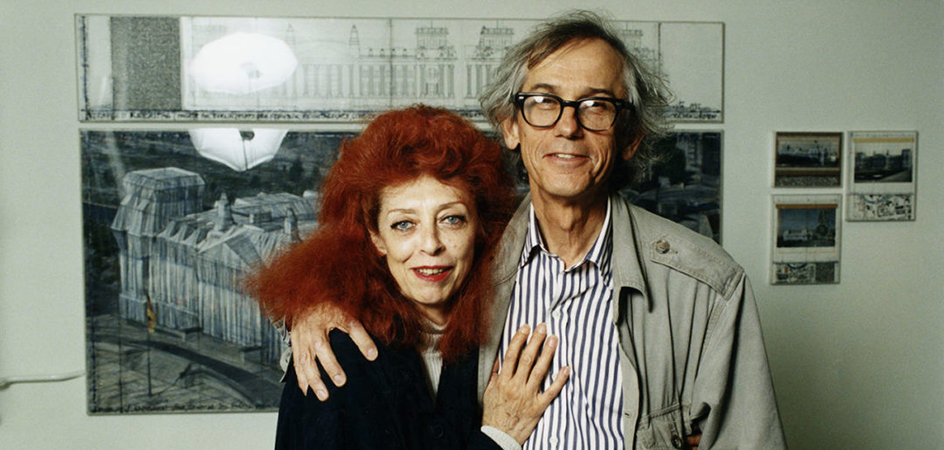
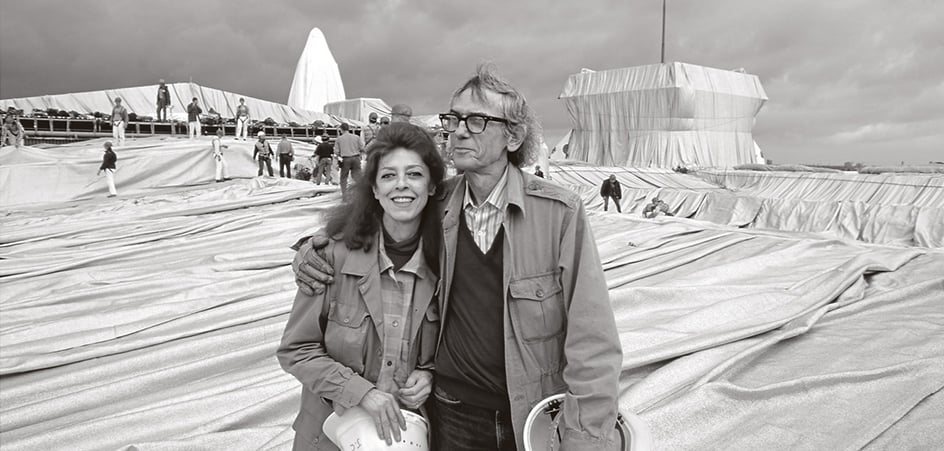
The love between Christo Anani Yavachev (1935) and Jeanne-Claude Denat de Guillebon (1935–2009) does not begin smoothly. Born on the same day, 13 June, they could not be more different: he, a shy Bulgarian émigré devoted to his art and she, a wealthy young woman of Moroccan origins, fully immersed in Parisian high society. It is in that very city that they meet in 1958, when Christo frequents the de Guillebon household to paint family portraits. In their first encounters, it seems impossible to foresee what will follow.
An irresistible sexual attraction—as they would later admit—makes them inseparable, to the point that when Jeanne-Claude marries her official fiancé, she is already pregnant by Christo. A discovery that shocks her family and forces them to live as outcasts, with very limited means. It is precisely in this moment of great difficulty that Christo conceives his first installation, realised solely thanks to Jeanne-Claude’s support. On 27 June 1962, the two occupy Rue Visconti with 89 oil barrels: an entire wall that blocks the traffic and asserts itself as a symbol of protest against the Berlin Wall, erected the previous year. As Christo unloads and arranges the barrels—amid the protests and curious glances of passers-by and motorists—Jeanne-Claude, with tireless powers of persuasion, manages to convince the police not to intervene. Wall of Oil Barrels – The Iron Curtain is the first of a long and extremely demanding series of interventions in which “the Christos”—as they would be dubbed by critics—work side by side. While many ideas originate with Christo, it is Jeanne-Claude’s organisational and managerial skills that make them feasible, and shared decisions—also in terms of materials and fabrics—are certainly not lacking. After Paris, their path becomes more defined and moves in a clear direction; their work increasingly consists of monumental “wrappings”. Entire monuments and iconic landmarks in cities and renowned locations around the world are covered and concealed from view, in an act of concealment that simultaneously reveals their presence. This is the case in Berlin, when in 1995 they wrap the Parliament, and later again in New York, Rome, Japan, California and Australia… Yet, despite the work being undeniably the result of both, the art world struggles to recognise Jeanne-Claude’s role—a bias thatwomen have long endured.
As confirmation of this inextricable bond, after Jeanne-Claude’s death Christo stated that he would not create any work other than those they had already conceived together.
Jackson Pollock and Lee Krasner: between emotion and devotion
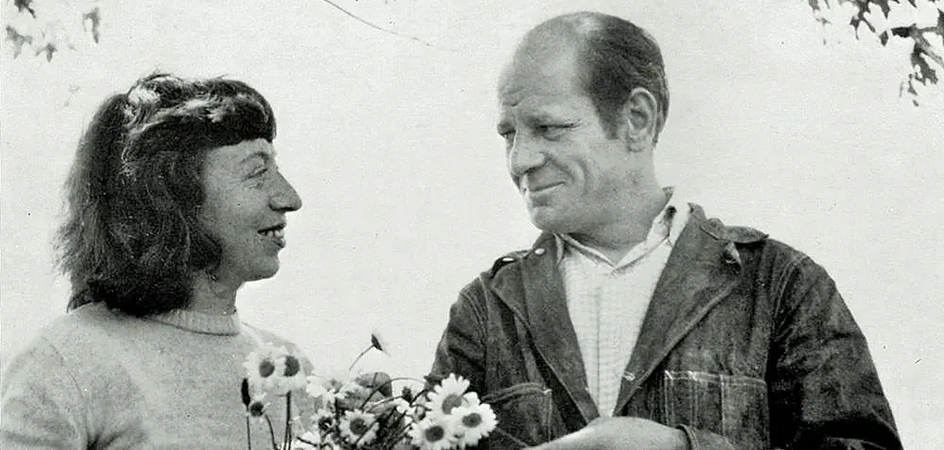
Equally different are Jackson Pollock (1912–1956) and Lee Krasner (1908–1984). For this very reason, their relationship—though deep and intense—is troubled and marked by drama. Both emerging artists, they meet in Manhattan in 1942, when they are invited, together with Willem de Kooning, to exhibit at the McMillan Gallery. It is love at first sight: they see each other frequently, and three years later they marry.
From their very first meeting, Lee—convinced of Jackson’s extraordinary talent—devotes herself to promoting him, securing contacts and advocating on his behalf: Pollock is known not only for his remarkable abilities, but also for his brusque and arrogant character, which his alcoholism—present since a very young age—does nothing to temper.
His talent is soon recognised by Peggy Guggenheim, an influential collector, gallerist and patron, who offers him a solo exhibition and a highly favourable contract, thanks in no small part to Lee’s effective support. As also portrayed in Ed Harris’s film, Lee and Jackson withdraw to live and work in a country house in Springs, in the East Hamptons. The early years unfold in an atmosphere of relative calm and serenity, although their rhythms are entirely different: she is methodical and an early riser, while he is nocturnal and instinctive.
These are the years in which Pollock establishes himself as “the greatest living painter in the United States”, as Time famously declared in 1949 with his portrait on the cover.
His dripping technique—the pouring and splattering of paint onto vast canvases—gains admiration and international attention.
From 1950 onwards, however, the harmony begins to unravel: Jackson resumes drinking, alienating and damaging his relationship with Lee and their entourage of friends and gallerists. The journeys between Springs and Manhattan become more frequent, and increasingly often Pollock stays away overnight. On one such occasion, he meets Ruth Kligman, a twenty-five-year-old model and painter, with whom he begins a relationship. The situation becomes unbearable for Lee, who decides to leave for France and then travel on to Italy, taking time to reflect on their relationship. Her journey is cut short by the news, which reaches her in Paris, of Jackson’s death: while driving his car, he crashes into a tree. With him are also Ruth and a friend of hers.
Today we have chosen these couples, but we will tell you about others. In love there are no rules, and no clear conclusions can be drawn, but one thing is certain: learning to stay together is truly a Sublime Art.