

Hair, especially women’s hair, has attracted interest across many periods and cultures. Short or long, loose or styled, displayed or covered, fashion reflects religious and political norms, social conventions, and becomes a visible language of identity and belonging. In the Renaissance, hairstyles became increasingly varied and elaborate, and women adopted them to assert their role and express their personality. Let’s explore this fascinating world through a selection of artworks from that period.
Historical context: women’s hair between the 15th and 16th centuries
Hairstyles of the 15th and 16th centuries tell us more than just fashion: they reflect an entire era shaped by rules, symbols and female aspirations. During this period, the ancient world inspired Renaissance intellectuals, artists and patrons, and admiration for classical antiquity permeated philosophy, art and craftsmanship. Court ladies, too, looked to the ancient past, finding in the effigies of Roman matrons—characterised by braids, buns and chignons—models of a new femininity ready to be imitated.
Yet the transition was not so straightforward, and the matter of hair became intertwined with religious ideology and the (pseudo-)scientific beliefs of the time.
Scholars of the period had revived the theories of Aristotle and Galen, according to which hair was a waste product, like faeces and urine, generated by bodily vapours. This extremely negative connotation aligned with the Christian morality promoted by theologians and preachers: for Renaissance churchmen, hair—especially women’s hair—was considered unworthy, a sign of lust and sensuality, and therefore had to be restrained or covered. This recommendation even entered, in some cases, into law, within the sumptuary regulations governing etiquette and social customs. To counter the lowly, almost excremental nature of hair, it had to be gathered and disciplined into orderly hairstyles, as a sign of modesty and respectability.
However, excessive care of the hair was also frowned upon, as it could lead to vanity and sin: those who devoted too much time to styling it risked tempting men and encouraging improper thoughts.
It is therefore no surprise that in the art of the 15th and 16th centuries, female figures are mostly depicted with carefully arranged and elaborate hairstyles. Exceptions occur only in subjects with strong symbolic meaning, portrayed with loose hair for precise allegorical purposes.
Despite the limitations of the time, women were able to transform their hair into tools of expression and identity, creating original styles that still speak of their personality today.
3 iconic Renaissance hairstyles
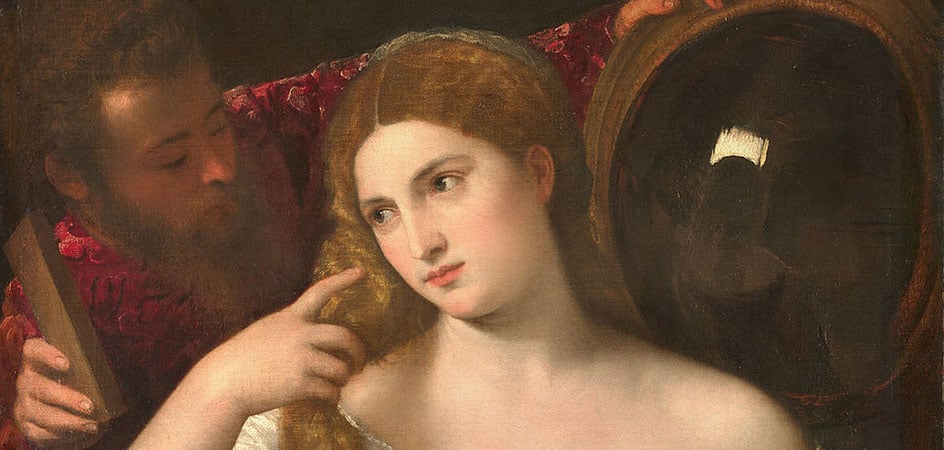
The ambiguous nature of women’s hair is also evident in the language of the time: the term capelli was used for men, while crine referred to women’s hair and animal fur. Yet women devoted considerable time and attention to their hair, both to style it—often with the help of maids and attendants—and to dye it, exchanging recipes and cosmetic advice. The red-gold hue seen in the paintings of Tiziano is particularly famous: a symbol of aesthetic perfection, it sparked a true craze among Venetian noblewomen, who were willing to spend long hours in the sun applying lightening treatments.
This practice, along with elaborate hairstyles, was often criticised and mocked by men of the time. However, such condemnation did not prevent women from continuing to style their hair.
Coazzone and capigliara: hairstyles in the fashion of the d’Este sisters
Beatrice d’Este—sister of the more famous Isabella and wife of Ludovico il Moro—is credited with introducing the coazzone to late 15th-century Milan, a hairstyle of Spanish origin. It consisted of a single braid starting at the nape of the neck and falling down the back, wrapped in ribbons and enriched with precious decorations, held in place by a cap and secured on the forehead with a lenza (a thin silk cord, itself adorned with a pendant). Cosmè Tura, in a portrait now unfortunately lost, depicted the duchess wearing this famous hairstyle, which can be recognised in many other paintings of the period, testifying to its popularity.

Just as today, however, fashions in the Renaissance were fleeting and quickly replaced by new trends, which everyone at court and beyond hurried to imitate in order to keep up with the times. Within a few years, the coazzone gave way to the capigliara, promoted by Isabella d’Este, Marchioness of Mantua and daughter of Ferdinando I d’Aragona, King of Naples. This voluminous hairstyle—resembling a doughnut-shaped headdress—consisted of a mass of hair, often artificial, held together by a net of varying density, embellished with gems and ribbons. An example can be seen in the Ritratto di donna by Nicolò dell’Abate (c. 1547–1550), housed in the Galleria Borghese in Rome, where a richly dressed lady wears a typical capigliara, with curls framing her face. Wearing it was not only a way to stay fashionable, but also a means of demonstrating closeness—and political allegiance—to the powerful noblewoman, a tastemaker and creator of many other hairstyles.
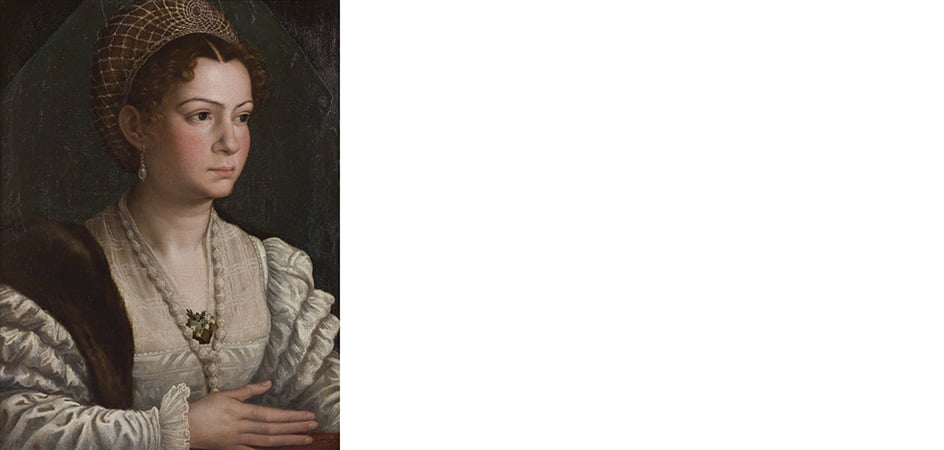
Hair gathered in the style of Eleonora da Toledo
It was also Isabella who popularised the fashion of wearing hair gathered into a bun and enclosed in a silk or gold net draped over the shoulders. The effect was both intriguing—at a glance the hair appears loose—and restrained, as it remained neatly “tamed” within the net.
The use of such accessories was not entirely new: already widespread in Aragonese Spain and, consequently, in the southern Italy region of Campania, it was also adopted by another charismatic figure of the time, Eleonora di Toledo, daughter of the Viceroy of Naples and wife of Cosimo I de’ Medici. Her hair was braided, secured at the nape and enclosed in a gold and pearl net, with a central parting. This is the hairstyle she adopted from 1548—when she arrived in Florence—and never changed thereafter. It is exquisitely documented in the many portraits painted for her by Bronzino, official painter of the Medici court.
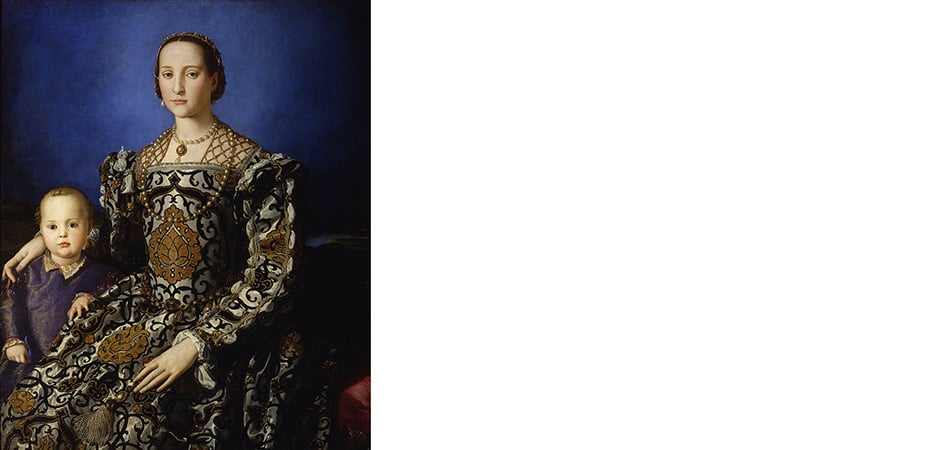
Loose hair: a powerful symbol with multiple meanings
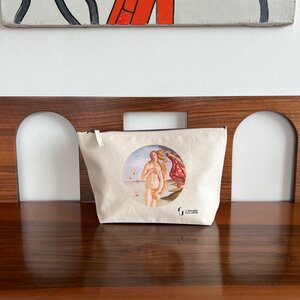
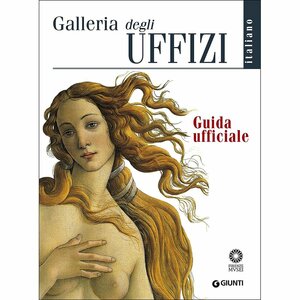
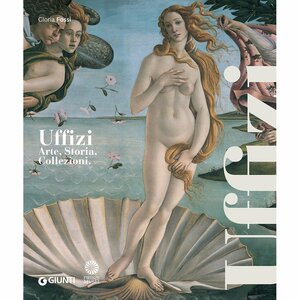
There is perhaps no more famous head of hair in the history of art than that of theVenere di Botticelli (c. 1485, Florence, Uffizi). Her long, soft hair flows freely in the wind, sensual and unrestrained, emphasising the erotic charge of the painting, already made explicit by the goddess’s nudity. A charge further reinforced by Aphrodite’s gesture: the lock of hair covering her genitals clearly alludes to pubic hair. This is an idealised image, far removed from the reality of noblewomen of the time, and derived from another well-known iconography.
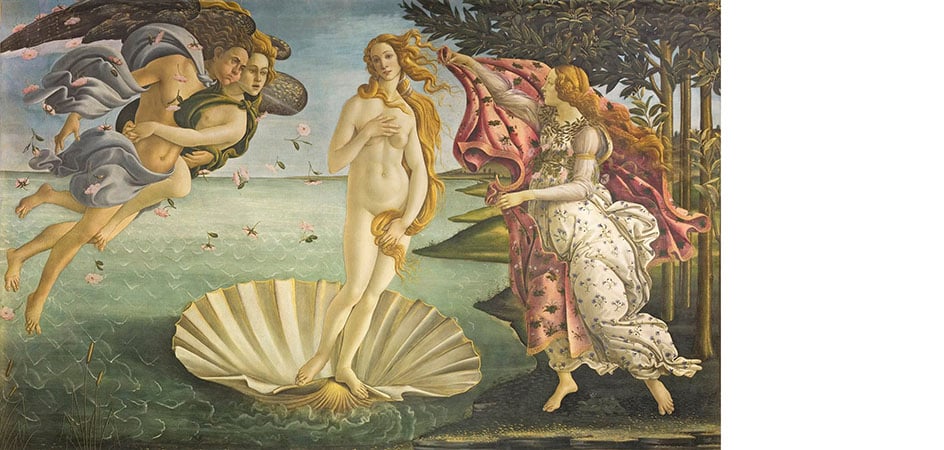
It is likely that, in depicting the movement of the divine hair, Botticelli drew inspiration from the famous Medusa with her deadly locks depicted in the Tazza Farnese (2nd–1st century BC, Naples, MANN – Museo Archeologico Nazionale di Napoli), which the artist had seen when it belonged to Lorenzo de’ Medici. The goddess’s flowing hair represents a fertile yet dangerous disorder, evoking lust and the loss of control women were believed to exert over men.

Yet loose hair does not speak only of eroticism: it is also used to signify repentance, as often seen in depictions of the penitent Magdalene. The most expressive example is undoubtedly the Maddalena by Donatello (1440–1442, Florence, Museo dell’Opera del Duomo), where the dishevelled hair underscores the condition of impurity and suffering of the saint, once a prostitute.

Loose hair can also carry a positive meaning when associated with certain saints, such as in representations of Caterina d’Alessandria, where it signifies her unshaken strength, or with newly married women, symbolising purity and fertility.
In a period so deeply rooted in codes and conventions as the Renaissance1, hair did not go unnoticed, and the attention paid to it by contemporary artists was far from accidental. Observing these hairstyles in the artworks of the time reveals a true silent language, rich in symbols and hidden meanings, often not immediately apparent to the untrained eye.
- In 1528, Baldassarre Castiglione published Libro del Cortegiano, a treatise on the manners and behaviours appropriate to the courtier, which in some ways anticipates the more famous Galateo by Giovanni Della Casa.