

The stories of women artists whose lives and voices must not be forgotten, and the origins and meaning of the red shoes that have become a symbol of the fight against violence against women.
Art history is filled with female figures: muses, goddesses, heroines, saints and icons. Women portrayed, admired and idealised, but also depicted in scenes of oppression and violence. Yet, when we look at history from the perspective of women artists, we discover that reality has all too often been remarkably close to the scenes depicted in their works.
Over the centuries, many women painters, sculptors, photographers and performance artists have had to confront not only the prejudices and obstacles imposed by society, but also experiences of abuse and physical and psychological violence, often within their own families or the artistic circles they frequented.
Some women have chosen to speak openly about their experiences, while others have used their work to explore themes of the body, memory and power dynamics. On the occasion of 25 November, the International Day for the Elimination of Violence against Women, we revisit five stories that deserve to be known and remembered, alongside the remarkable women artists at their heart.
Artemisia Gentileschi (1593 – after 1654)
One of the most important figures in Italian Baroque painting, Artemisia Gentileschi stands out for her extraordinary talent and the expressive power of her works. The daughter of the painter Orazio Gentileschi, she grew up in Caravaggio’s Rome, taking her first steps as a painter in her father’s workshop.
Around 1611, the most dramatic and tragically well-known episode of Artemisia’s life unfolded. Agostino Tassi, a painter to whom her father had recently entrusted her as an apprentice, raped her in the Gentileschi family home on Via Croce in Rome, while Orazio was away on business. Tassi continued to abuse her psychologically and physically for months.
When Orazio decided to press charges against his colleague the following year, the case became a major scandal that reverberated throughout Rome. Despite the deep trauma and damage to her reputation, Artemisia found the strength to fight back, voluntarily submitting to humiliating public gynaecological examinations and harrowing interrogations under torture in an attempt to bring her attacker to justice. During one of these sessions, she was even subjected to the sibille torture, which involved tying cords around her fingers and gradually tightening them with a mechanical device. Besides causing excruciating pain, this treatment could permanently damage her fingers, potentially jeopardising her future as a painter.
Yet Artemisia endured, and in 1612 Agostino Tassi was finally convicted and sentenced to exile from Rome. That same year, Gentileschi married the Florentine Pierantonio Stiattesi, and in 1614 the couple moved to Florence.
Despite this terrible experience, Artemisia continued to pursue her career, establishing herself as a prominent artist in Florence, Rome, Naples and even London. In 1616, she became the first woman admitted to the Accademia delle Arti del Disegno in Florence, the prestigious institution envisioned by Michelangelo and officially founded by Vasari in the previous century.
It was towards the end of her stay in Florence that she produced some of her most celebrated works, paintings that perhaps more than any others reveal the strength of her character and the lingering shadow of her past. Their subject is Judith, the Old Testament heroine who defies her oppressor.
Giuditta con la sua ancella (1618–1619), now housed in the Galleria Palatina, and Giuditta che decapita Oloferne (1620), on display at the Uffizi, depict two different moments from the same biblical episode: the killing of the Assyrian general Holofernes by Judith, a Jewish widow from the besieged city of Bethulia who deceives, seduces and ultimately kills her enemy. The latter painting has often been interpreted as a reflection of the violence endured by the artist, although its expressive richness cannot be attributed solely to that experience.
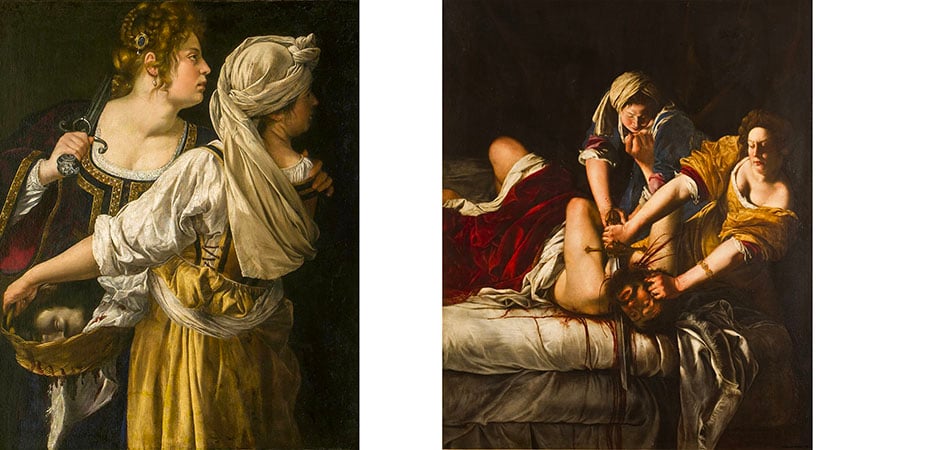
What strikes us most is the strength of her female figures: courageous, fearless and proud in the face of domineering and oppressive men. Artemisia spares us none of the gruesome, realistic details, such as the blood gushing from Holofernes’ severed neck, staining the sheets and the chest of the young avenger.
In Artemisia’s paintings, from Giuditta to Susanna e i vecchioni, female protagonists acquire extraordinary energy and psychological depth, expressing courage and determination, but also fear and distress, through a powerful and highly original pictorial language.
Niki de Saint Phalle (1930–2002)
Vibrant colours, monumental forms and exuberant female figures: Niki de Saint Phalle’s artistic world is as imaginative as it is provocative. A painter, sculptor and tireless experimenter, she created works that challenged the conventions of her time, moving from painting to performance and large-scale installations. Yet behind this explosion of colour and creativity lies a personal history marked by a painful childhood.
Born in France in 1930 into an aristocratic Franco-American family, she spent much of her childhood and adolescence in New York. She grew up in a wealthy household, but one governed by strict rules and profound family contradictions. At just eleven years old, she was sexually abused by her father, a traumatic experience she kept secret for decades. She would only reveal it publicly in 1994, in her autobiographical book Mon Secret, written as a letter to her daughter Laura.
As a young woman, she worked as a model for magazines such as Vogue and Life, and soon married the writer Harry Mathews, with whom she had two children. In 1953, following a severe nervous breakdown, she was admitted to a psychiatric clinic. It was during this period that she discovered painting, a revelation that would prove to be the turning point in her life.
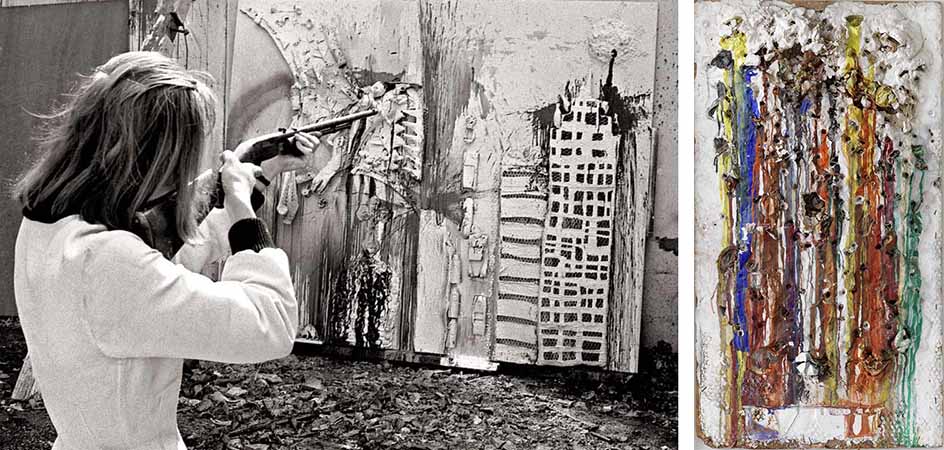
In the early 1960s, she created the celebrated Tirs, or Shooting Paintings. Niki assembled everyday objects, such as toys, utensils and pieces of metal, on large wooden panels, together with bags filled with coloured paint, covering the entire composition with a layer of white plaster. Once the work was prepared, she would shoot at it with a rifle, often in front of an audience. The bullets burst the bags of paint, which then flowed down the surface, creating unpredictable compositions. Through this violent and provocative gesture, Niki transformed destruction into an act of creation, challenging artistic conventions while denouncing violence and the power dynamics of society.
From 1964 onwards, she began creating the famous Nanas, large female sculptures with voluptuous forms and brilliant colours, symbols of strength and freedom that defied traditional beauty standards. In 1966, together with artists Jean Tinguely and Per Olof Ultvedt, she created Hon – en katedral (She – A Cathedral) for the Moderna Museet in Stockholm. The work depicted an enormous reclining female figure, which visitors could enter through the vagina. Inside the sculpture was an entire world to explore, complete with a cinema, a bar and even a slide for children. A surprising and provocative installation that transformed the female body into a monumental space, celebrating its vitality and creative power.
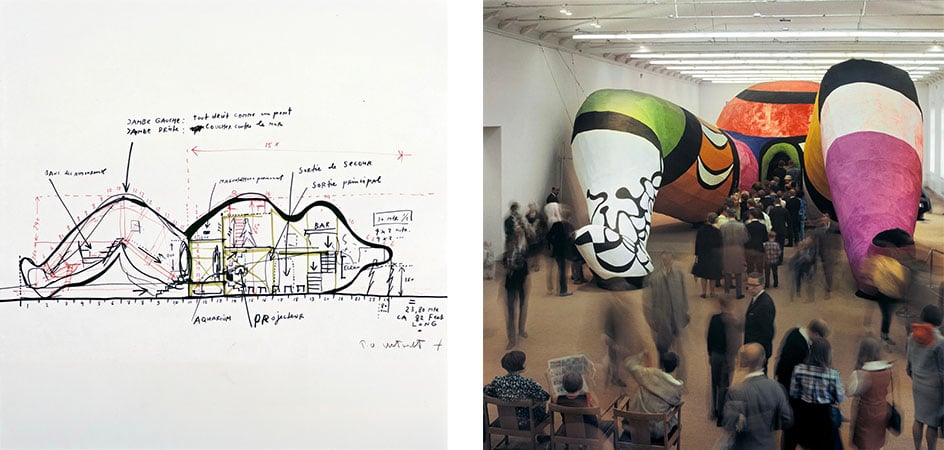
In her work, the memory of a painful past coexists with an extraordinarily vivid imagination, finding one of its most spectacular expressions in the Giardino dei Tarocchi in Capalbio, Tuscany, also inspired by Antoni Gaudí’s fantastical gardens.
From the violence of the Tirs to the exuberance of the Nanas, Niki de Saint Phalle developed an increasingly free and imaginative artistic language without ever losing its provocative force. In her works, even joy becomes an act of rebellion, challenging social conventions and celebrating female strength and independence.
Ana Mendieta (1948–1985)
The body, nature, identity and belonging are central themes in the work of Ana Mendieta, a Cuban-American artist who made her own body and natural elements the instruments of an original artistic language, combining performance, photography and Land Art. Her research was deeply connected to her personal history, particularly the experience of exile and separation from her homeland.
Born in Havana in 1948, Ana grew up in a wealthy family increasingly concerned about the political changes brought about by Fidel Castro’s revolution. In 1961, at just twelve years old, she was sent to the United States with her older sister Raquelín as part of Operation Peter Pan. Supported by American Catholic organisations, the programme enabled more than 14,000 Cuban children to leave the island without their parents between 1960 and 1962, amid the political tensions following the revolution.
The two sisters first arrived in Miami before being transferred to Iowa, where they spent several years moving between institutions and foster homes. Ana was not reunited with her mother until 1966, while her father joined her much later, in 1979. The experience of displacement and separation from her roots would profoundly influence her artistic sensibility.
In the late 1960s, she began studying at the University of Iowa, where she became interested in performance art and artistic experimentation centred on the body. During several trips to Mexico, she also rediscovered her connection with Latin American culture and landscapes, which would become essential to her work.
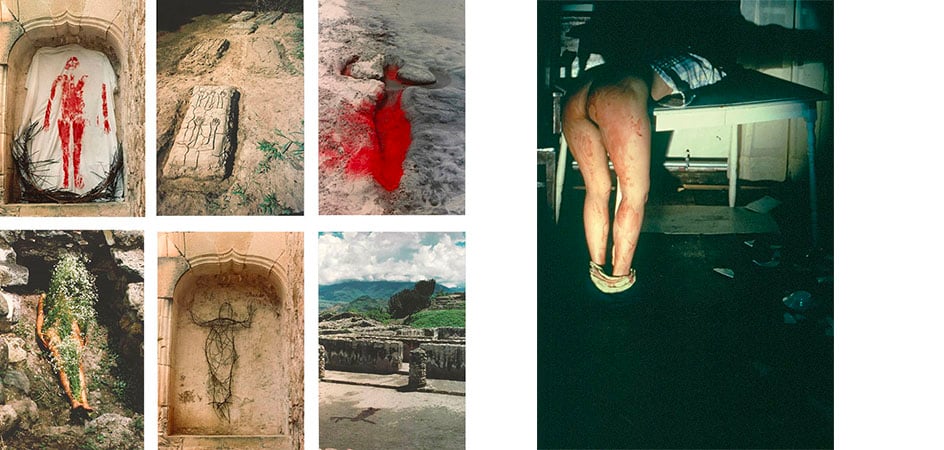
In the 1970s, Mendieta began using her own body as a central element in her art. In the celebrated Silueta series, begun in 1973, she created female silhouettes in the earth, sand and vegetation, using natural materials such as flowers, mud and fire. Sometimes she imprinted her own figure directly onto the landscape; at other times, she left only its outline, documenting these ephemeral creations through photographs and films. These images evoke the relationship between human beings and nature, but also the longing to recover a sense of belonging after the experience of exile.
That same year, she created Rape Scene, a performance conceived in response to the rape and murder of a student at the University of Iowa. Mendieta recreated the crime scene in her own apartment, using her body to confront viewers with the brutality of sexual violence.
Her artistic practice attracted growing interest, and after moving to New York in 1978, she received prestigious grants and fellowships, including a Guggenheim Fellowship. In 1983, she was awarded the Rome Prize by the American Academy in Rome, allowing her to spend time in the Italian capital, where she further developed her sculptural practice and experimented with new materials. Her career was flourishing, establishing her as one of the most original voices in contemporary art.
Her career came to a tragic end on 8 September 1985, when, at just thirty-six years old, she fell from the window of the New York apartment she shared with her husband, the renowned Minimalist sculptor Carl Andre, whom she had married only a few months earlier. Tensions and jealousy between the two artists were apparent. Andre was charged with her murder, but was acquitted in 1988, as the evidence, although substantial, was not considered sufficient to establish his guilt beyond reasonable doubt.
Mendieta’s controversial death continues to raise questions within the art world. Over the years, numerous exhibitions dedicated to Andre have been met with protests and calls for justice, both regarding the circumstances of Mendieta’s death and the recognition of her artistic legacy. Her tragic story invites us to reflect on how the memory of women and the value of their work are recognised and preserved. A question that remains relevant today.
Nan Goldin (1953)
In the photography of Nan Goldin, private life and artistic practice are inseparably intertwined. Her photographs tell stories of friendships, love, relationships and vulnerability, offering an intimate and unfiltered portrait of New York’s underground scene during the 1970s and 1980s.
Born in Washington in 1953, Goldin grew up in a family marked by profound difficulties, including the suicide of her older sister Barbara when Nan was still a teenager. She developed an interest in photography at a very young age, moving first to Boston and then to New York, where she became involved in the city’s artistic and underground communities. There, she began documenting the everyday lives of friends, couples and those closest to her, developing an intimate, unfiltered and strikingly innovative photographic style.
The Ballad of Sexual Dependency emerged from these years of experience. Begun in the 1970s, the project was initially presented as a slideshow in New York’s nightlife venues. The images explore love, sexuality, obsession, addiction and the contradictions of intimate relationships, without shying away from their rawest and most painful aspects.
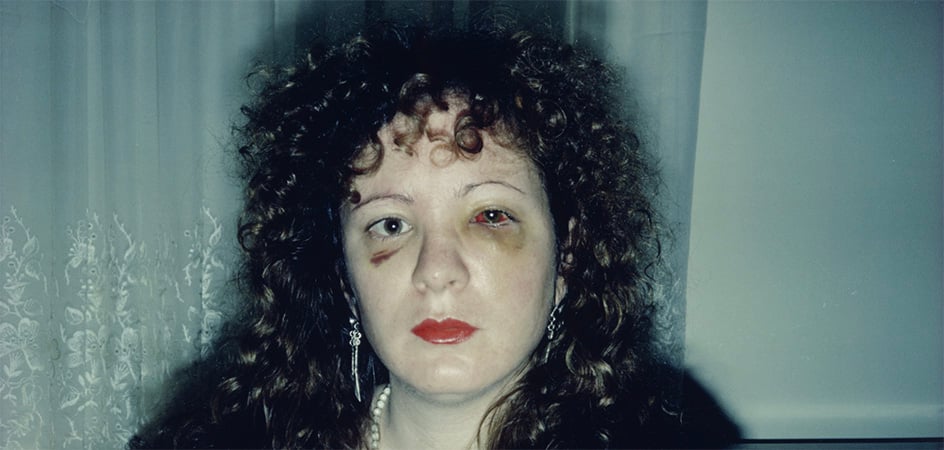
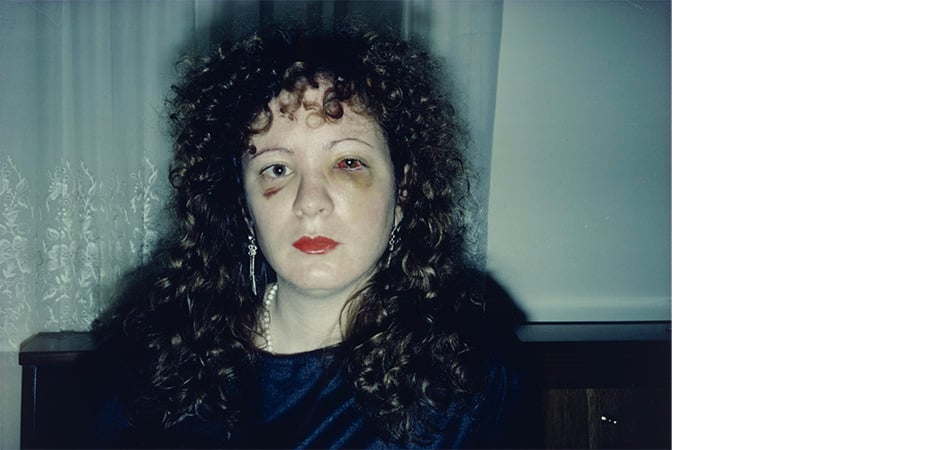
Among these photographs is Nan One Month After Being Battered (1984), a self-portrait taken one month after a violent assault by her partner, Brian. The attack was so brutal that she almost lost an eye. In the photograph, Goldin appears with her face still bruised, her eyes swollen and inflamed, and her gaze fixed directly on the camera. Posed, dressed and wearing make-up, she refuses to be defined solely by her victimhood. Instead, she transforms a personal experience into a public testimony to domestic violence, exposing the consequences of the assault without concealment. The photograph became one of the most iconic images of her career, offering an extraordinarily powerful exploration of the boundaries between love, dependency and abuse.
In the following years, Goldin continued to use photography to tell stories that were often overlooked, particularly documenting the devastating effects of the AIDS epidemic on New York’s artistic and underground communities. Many of her friends, captured in the photographs of The Ballad of Sexual Dependency, lost their lives to the disease. Among them was the actress and writer Cookie Mueller, to whom Goldin dedicated a series of photographs documenting the final years of her life. In 1989, she also organised the exhibition Witnesses: Against Our Vanishing, giving visibility to those affected by the epidemic and challenging the silence surrounding them.
Her commitment continued in more recent years when, having personally struggled with an addiction to prescription opioids, she founded P.A.I.N. (Prescription Addiction Intervention Now) in 2017. The organisation campaigns against the pharmaceutical industry’s role in the American opioid crisis and challenges the financial contributions made by the Sackler family to major museums and cultural institutions. This struggle is at the heart of the documentary All the Beauty and the Bloodshed (2022), directed by Laura Poitras and winner of the Golden Lion at the Venice International Film Festival. Her remarkable journey has made Nan Goldin not only one of the most influential photographers of our time, but also a powerful advocate for people whose lives and experiences are too often overlooked.
Elina Chauvet (1959)
Art becomes a powerful instrument of protest and social awareness, as demonstrated in Zapatos Rojos (Red Shoes), a project launched in 2009 by Mexican artist Elina Chauvet in Ciudad Juárez, a city tragically known for its high number of femicides and missing women.
Born out of the artist’s grief and trauma following the murder of her sister, the installation initially brought together dozens, and later hundreds, of pairs of red shoes. Each pair represents a woman who has disappeared or been murdered in an act of femicide: left empty in public spaces, the shoes make their absence almost tangible.
Over the years, the project has travelled across countries and communities, becoming an international symbol of remembrance, solidarity and protest. A reminder not to forget the individuals behind the statistics, and to turn attention into awareness.
Five women artists, whose lives unfolded in different eras and contexts, reveal the many forms that violence can take, reminding us that the art world, too, reflects the contradictions of society.
For some of these women, their personal experiences became an integral part of their artistic practice; for others, the relationship between biography and art is more complex. Remembering them therefore means refusing to define them solely by the violence they endured, and instead recognising the value of their works and their contribution to art history.
An important number to know and share: 1522
1522 is Italy’s national public helpline for victims of violence and stalking, promoted by the Department for Equal Opportunities. The service is free, anonymous and available 24 hours a day, seven days a week, offering support in Italian, English and several other languages. Trained operators provide information, assistance and guidance towards local anti-violence centres and support services.
You can contact the helpline even if you simply need advice, or use the online chat available on the official website: 1522.eu.