

Not all castles have remained under the administration of the same family throughout the centuries.Not all castles preserve the unchanged charm of past eras. Not all castles are inhabited by a ghost who, when displeased, makes its feelings known to the living. Not all of them – but the Rocca Meli Lupi di Soragna, in the province of Parma, certainly does. This ancient medieval castle transformed into a princely residence is home to Diofebo VI Meli Lupi, noble descendant of the historic family line, and still safeguards treasures and mysteries waiting to be discovered, including a spectral presence…
The Interiors: an immersion into Baroque splendour
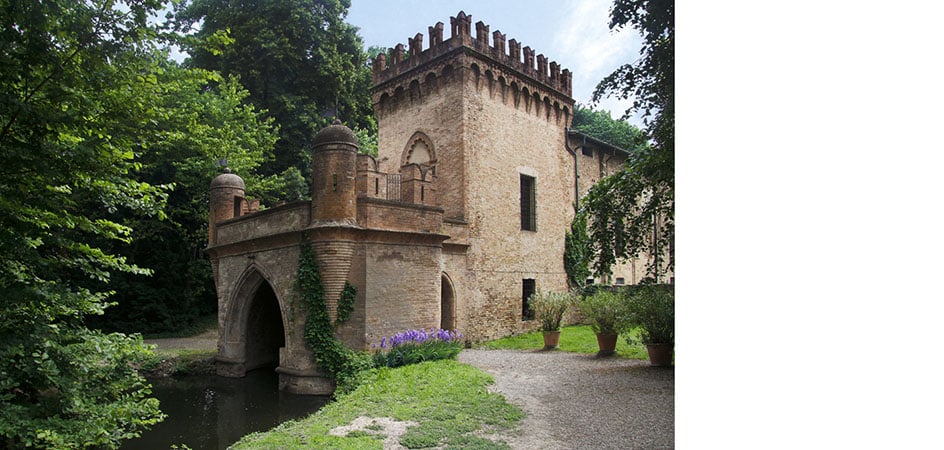
At first glance, visitors are immediately struck by the scale and austerity of the building. Originally built as a defensive fortress at the end of the 14th century – when the marquises Bonifacio and Antonio Lupi received feudal investiture over the territory from Charles IV – the castle underwent several structural transformations beginning in the 16th century. Over time, the military needs for which it had been built (still testified today by the four corner towers and the central tower) gradually disappeared, and the palace adapted to its new residential role. Despite the alterations and modernisations, it never lost its original sobriety, enhanced by the brick exterior and the absence of decorative elements, in striking contrast with the lavishly decorated and sumptuous interiors.
Passing the two lion sculptures at the entrance, we cross the masonry bridge spanning the dry moat and enter this splendid princely residence. A carpet of climbing plants covers the walls of the inner courtyard and harmonises beautifully with the atmospheric portico, frescoed in 1446 with vine shoots and branches. From here begins the exploration of the castle’s many rooms: let us step inside some of them together.
Sala Baglione: a triumph of grotesques
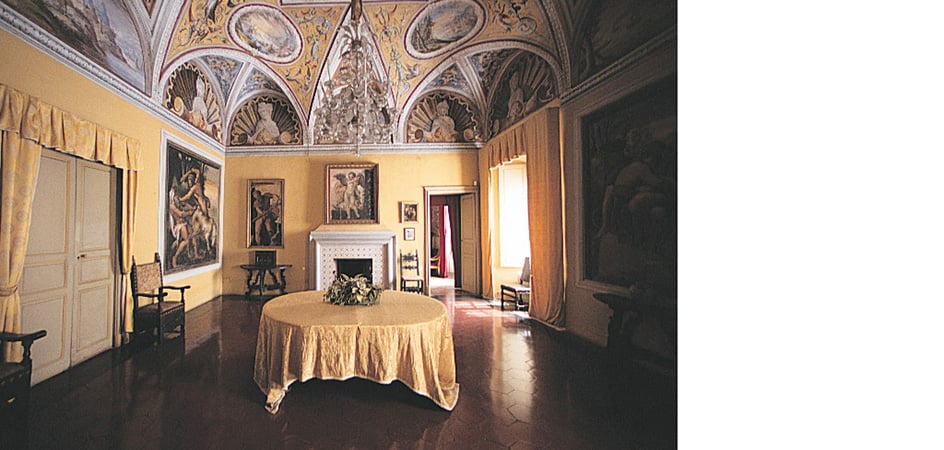
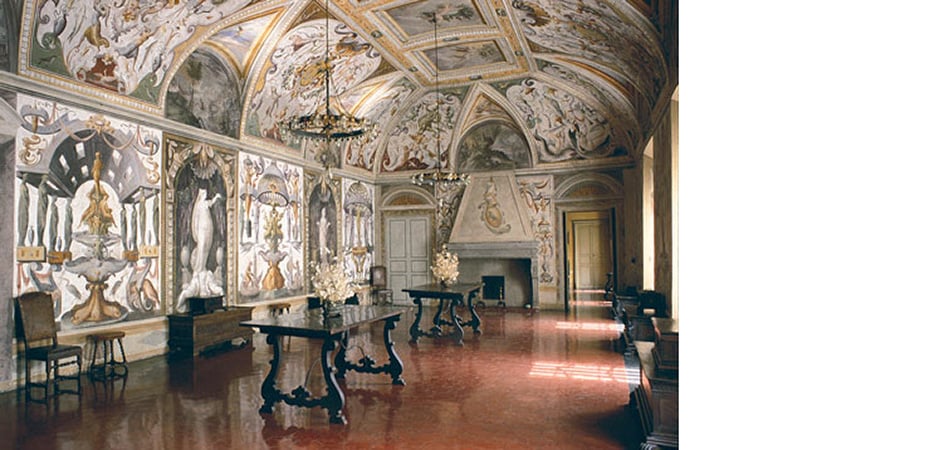
Located in the right wing of the palace, the Sala Baglione takes its name from the painter Cesare Baglione (c. 1550–1615), who frescoed its vault and walls. His passion for optical illusion, fantastical landscapes and above all grotesque decoration is expressed here with extraordinary variety and originality. The room comes alive with perspective games, female figures, imaginary views and intricate decorations arranged in a masterful balance between fullness and emptiness, creating an enchanting and truly unique atmosphere. Another remarkable feature is the niche with wooden doors decorated externally with grotesques and internally with religious symbols: most likely an altar for private worship.
The Sala degli Stucchi and the Galleria dei Poeti
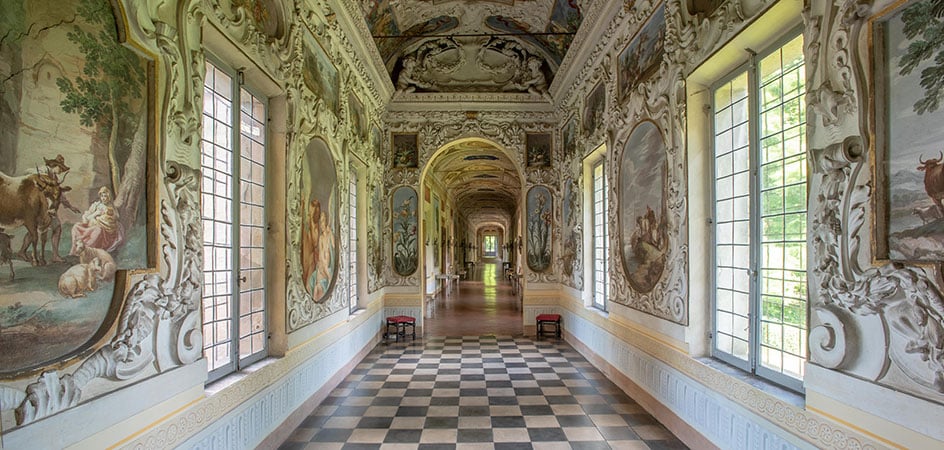
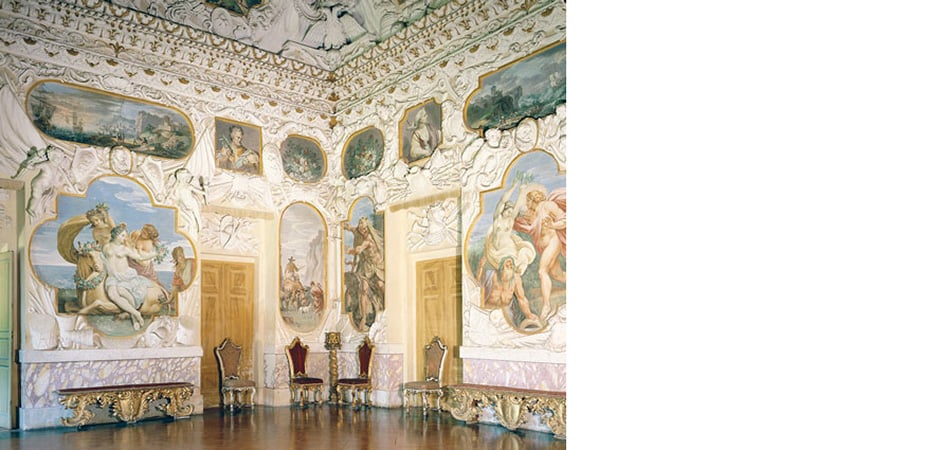
The central wing of the palace unfolds through a series of rooms, each characterised by distinct styles, functions and decorative schemes. Particularly noteworthy are the decorations of the Sala degli Stucchi, named after the magnificent sculptural stucco work created by Ferdinando (1657–1743) and Francesco Galli (1659–1739), known as “the Bibbiena”, authors of many other interventions within the Rocca. They were also responsible for the wall paintings celebrating the Meli Lupi family.
Equally majestic is the Galleria dei Poeti: divided into three sections and executed by several artists, including the Bibbiena, it displays twelve portraits of illustrious poets.
The Grande Galleria: a tribute to family history
We now ascend to the first floor via the grand staircase and allow ourselves to be captivated by the beauty of the rooms, unfolding in a triumph of frescoes and gilded decoration in unmistakable Baroque style. The Grande Galleria – furnished with only a few carefully selected pieces – enchants visitors thanks to its wall paintings, once again by Francesco Galli and dedicated to the history of the Meli Lupi family. Particularly striking is the scene on the far wall depicting a banquet held during Emperor Charles V’s visit to the Marquis of Soragna.
Connected to this gallery are two smaller ones: the 18th-century Piccola Galleria, decorated by the Bibbiena, and the delightful Galleria Gonzaga, more recently decorated (in 1942) and inspired by the Guards’ Gallery in Palazzo Gonzaga at Sabbioneta.
The Sala del Trono and the Camera Nuziale: two Baroque gems
What princely residence would be complete without a throne room? Although the noble throne itself is no longer present, the Sala del Trono at the Rocca di Soragna still evokes the magnificence of the family’s glorious past. This is thanks to the velvets and brocades adorning the walls and to the imposing canopy which, with its drapery and golden ornaments, dominates the room. The furnishings are essential yet precious, while two refined wooden sculptures by Lorenzo Aili (c. 1657–1702), representing Primavera and Autunno, stand out prominently. Their companions, Inverno and Estate, can be found in the Camera Nuziale.
And it is precisely here that we enter, once more astonished by the sumptuousness of the decorations. The walls are covered in luxurious fabrics, while two majestic Murano mirrors with glass and crystal frames bearing the Meli Lupi coat of arms add further splendour. The wedding bed, with its ornate canopy, is set within a deep alcove separated from the rest of the room by a carved and gilded wooden gate.
The English landscape park: a place of peace and romance
Before leaving the Rocca, we strongly recommend visiting the enchanting park behind the palace. Designed in the 18th century as an Italian garden, it was transformed in the following century into a typical English landscape park by the architect Luigi Voghera, from Cremona, and it has remained so ever since. Today it offers visitors a delightful walk among Japanese beeches, ginkgo biloba trees, hazels, magnolias, horse chestnuts and countless other botanical and floral species, arranged to create the illusion of an endless garden dotted with picturesque views. The artificial lake, with its Isola dell’Amore adorned with grottoes featuring stalactites and stalagmites, adds a romantic touch to the visit. The neoclassical Caffè Haus and greenhouse are also worthy of note, housing a remarkable collection of statues and beautifully fragrant roses.
The castle ghost
As mentioned earlier, the Castle of Soragna is unlike any other. Those who stay overnight may encounter a rather curious experience. Alongside the current owner, legend says that the Rocca is also inhabited by the ghost of Cassandra Marinoni, wife of Marquis Diofebo II Meli Lupi, who lived during the first half of the 16th century and was murdered by her brother-in-law.
The man – Count Giulio Anguissola, known for his violent and irascible temper – had married the marchioness’s sister, Lucrezia, who lived with him in Cremona, where Cassandra often travelled. During one of these visits, Anguissola, seized by sudden rage, brutally attacked both women. Lucrezia died from multiple stab wounds, while Cassandra, mortally wounded, was immediately taken back to the Rocca, where she died a few days later. The nickname “Donna Cenerina”, by which she is still known today, derives from the ashen complexion she assumed after the fatal injury. Legend has it that her spirit has inhabited the grand residence ever since, revealing its presence whenever it pleases: it is said that if she takes a dislike to a guest, sinister noises echo through the rooms in the middle of the night, doors slam shut without warning, and windows shatter into a thousand pieces for no apparent reason.
If you are ready for a vertiginous journey through the long history of the Rocca di Soragna, remember to plan your visit and purchase your ticket in advance – you certainly would not want to upset the marchioness!