

Perched among the gentle hills of Chianti (in the province of Florence), San Casciano Val di Pesa is a picturesque medieval village, home to historic villas, noble estates and ancient churches. One of these, the Church of Santa Maria del Gesù, also known as the Church of the Suffragio, now houses one of the most remarkable local museums in the entire area: the Museo Ghelli. Here, archaeological finds, medieval artefacts and an extensive collection of sacred art sit alongside contemporary works and the substantial collection of work by Giuliano Ghelli, an internationally renowned Tuscan artist. Do not be misled by the church’s unassuming façade: inside lies a truly unique heritage.
The Church of the Suffragio, from sacred space to museum
Part of the charm of this remarkable museum lies in its setting. The Church of Santa Maria del Gesù is itself an integral part of the visitor experience and houses panel paintings and sculptures dating from the 15th and 16th centuries. Built in the 15th century by Franciscan friars, it owes its present appearance to subsequent rebuilding. Initially used as a stopping place between the convents of Fiesole and Poggibonsi, it was soon converted into a convent for the Poor Clares. In the first half of the 17th century, the monastery was renovated and for around two centuries was home to Benedictine nuns, before being suppressed under Napoleonic laws. From then onwards, its function changed frequently: it first housed the Compagnia del Suffragio, responsible for transporting the dead to the cemetery; then a military command; and in 1922 it became a base for Fascists taking part in the March on Rome. During the Second World War, the church was bombed and completely rebuilt in the years that followed, with no regard for the original architecture. The external portico – absent from the 17th-century layout – and the austere interior date from this period. After a period in which the church served as a public school, it was converted into a museum of sacred art; today it is home to the Museum of San Casciano, which extends through the church itself and the adjoining rooms.
The Museum is divided into three sections: sacred art, comprising works of art, furnishings and liturgical vestments from various churches in the surrounding area; archaeology, featuring finds from the local Etruscan and Roman periods; and finally contemporary art, devoted primarily to Giuliano Ghelli (1944–2014) – who made San Casciano his home and after whom the Museum is named – and other prominent figures on the local art scene.
Sacred art: 3 works of great importance
The extensive and varied collection of sacred art is displayed throughout the church and the rooms on the ground floor of the museum. Among its valuable artefacts and objects, several works stand out in particular.
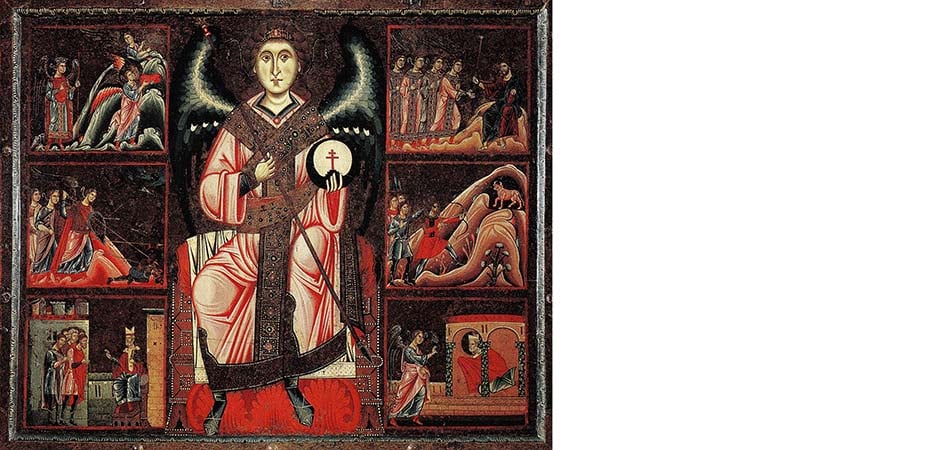
San Michele Arcangelo e storie della sua leggenda by Coppo di Marcovaldo
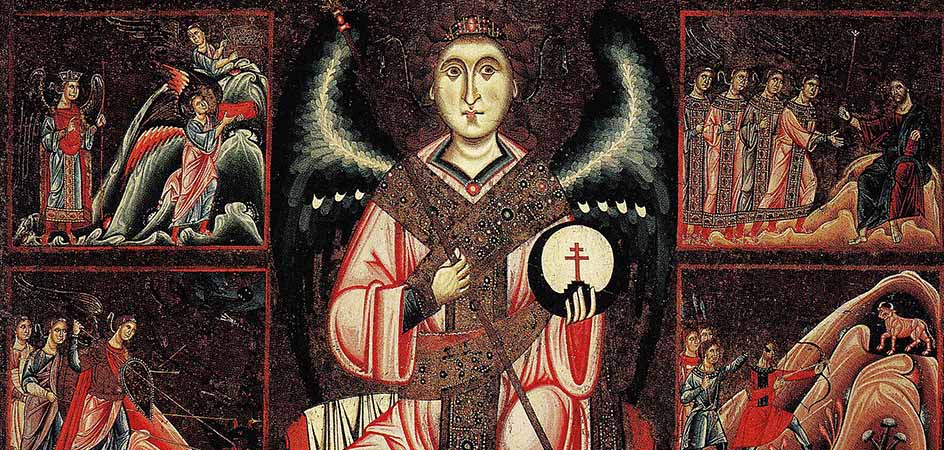
The first work we would like to mention is San Michele Arcangelo e storie della sua leggenda, dating from between 1250 and 1260 and attributed to Coppo di Marcovaldo, the most celebrated Florentine painter before Cimabue and Giotto. At the centre of the panel, a majestic St Michael – holding a cross-bearing orb and a cross in his hands – sits enthroned, with regal attire and bearing. His long Eastern-style tunic, its graphic treatment and his perfectly frontal pose reveal the Byzantine influence on the work. On either side of the saint, we see six episodes from his life, to be read from right to left and from top to bottom. The scenes have not received a unanimous interpretation, but among the most recognisable is the Miracolo del toro sul santuario di San Michele nel Gargano (the central panel on the right), where we see the saint in the form of a bull being hunted: an action charged with tension despite the simplicity of the depiction. Indeed, in this work Coppo di Marcovaldo skilfully combines the hieratic quality of the central figure with the dynamism of the side panels, creating a remarkably balanced narrative.
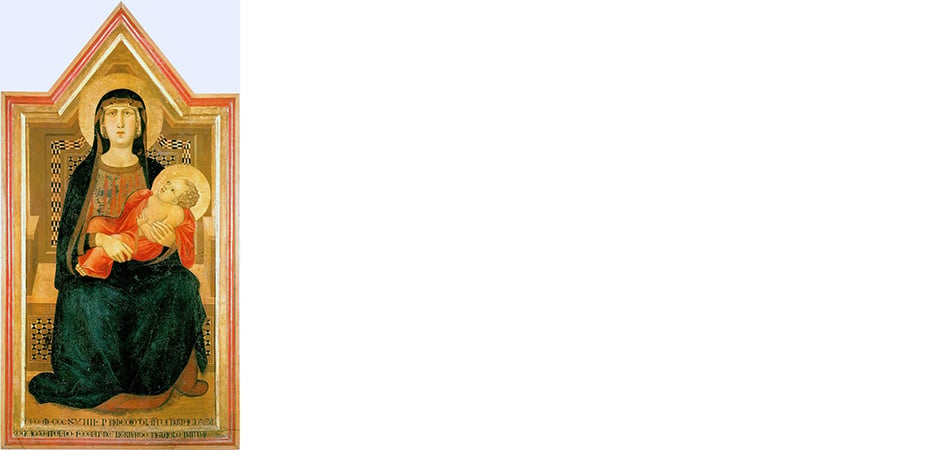
Madonna di Vico l’Abate by Ambrogio Lorenzetti
The Madonna di Vico l’Abate (1319) comes from the nearby Church of Sant’Angelo at Vico l’Abate – the same church as Coppo’s San Michele – and is the earliest documented work by Ambrogio Lorenzetti, one of the great masters of the 14th-century Sienese school. Twenty years younger than Giotto, Lorenzetti already shows at this date a sensitivity to the expressive innovations of the Florentine master. The Virgin, seated on a golden throne with a richly decorated backrest, appears solid, monumental and voluminous, aloof in her upright frontal pose. With her penetrating gaze and maternal gestures, she looks directly at the viewer while holding the infant Jesus firmly in her hands. Restless, the Child seems to want to wriggle free from his mother’s grasp and seeks her gaze, just as any ordinary baby would. It is precisely this ability to make the scene human and authentic that distinguishes Lorenzetti’s skill: he has always been admired for the originality and realistic quality of his painting.
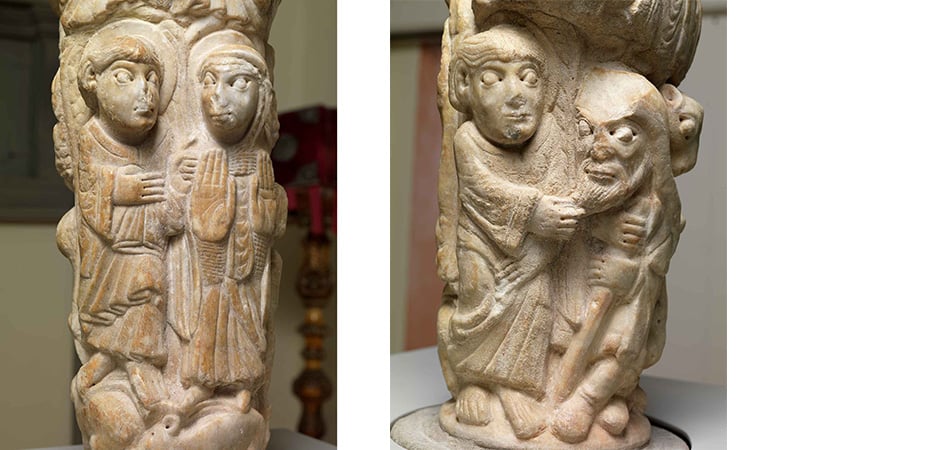
Il pilastrino con le storie della Natività di Cristo by the Master of Cabestany
This small shaft made of calcareous alabaster, carved in the second half of the 12th century and attributed to the Master of Cabestany, holds more than one mystery. We do not know where it was originally located or what its function was. The carved scenes – Annunciazione, Annuncio ai pastori, Natività, Bagno del Bambino – suggest that it may have supported a baptismal font; other theories suggest that it formed part of an altar, while others propose that it served as a candlestick for the Paschal candle. What is certain is that it was used as a holy-water stoup. Its authorship was also debated for a long time, and it has only recently been attributed to the Maestro di Cabestany (an anonymous French sculptor active in France, Italy and Spain). Among the scenes – which seem to emerge from the stone – the Bagno del Bambino is particularly striking, prominently positioned above the Annunciazione, as though indicating a direct relationship between purification and redemption. A curious detail is also hidden in the Annuncio ai pastori: the angel – the same one who appears in the Annunciazione – wakes the shepherd by pulling his beard.
The archaeological section and the imposing Stele dell’arciere
On the first floor of the Museum, the archaeological section brings together the most representative finds unearthed during excavations in the San Casciano and Val di Pesa area – including small Etruscan bronze statuettes and precious objects made of ivory and bone – bearing witness to more than a thousand years of local history. The most important piece in this section marks the beginning of the visitor route: a 7th-century BC Etruscan stele bearing the monumental figure of an ancient archer, from the burial mound that takes its name from him, the Tomba dell’Arciere. Discovered almost by chance in the locality of La Collina – where agricultural work in 1978 brought the first worked stones back to the surface – the tomb still contained various elements of the burial. Unlike the others, however, the figure of the archer is carved in extremely low relief, just one and a half centimetres deep.
The warrior (or perhaps a hunter) strides towards the right, his bow drawn and its string ready to release the arrow: a rather rare image in Etruscan art of the period.
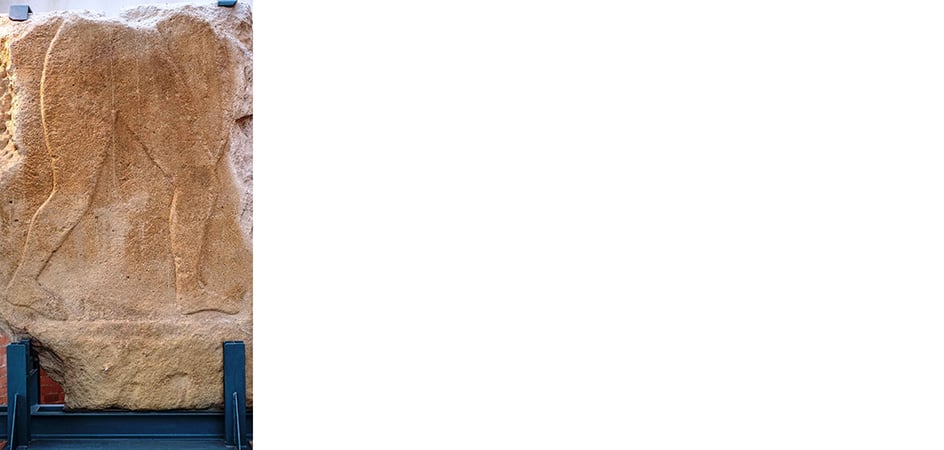
Of the original slab, which must have stood more than three and a half metres high, only the lower section has survived, although it remains imposing: more than two metres of stone weighing around two tonnes. Scholars believe that it was positioned at the top of the burial mound and that it fell and broke not long after it was erected; the larger fragment was subsequently reused to seal the entrance to the tomb permanently.
After its discovery, the stele remained for decades in the storerooms of the Museo Archeologico of Florence before finally finding a home in the Museo di San Casciano in the early 2000s, where today it welcomes and amazes visitors.
Contemporary art and the enduring legacy of Giuliano Ghelli
The final stage of the visitor route through the Museo Giuliano Ghelli is devoted to contemporary art: a constantly evolving section, with works displayed on a rotating basis, focusing particularly on artists who were either born in Chianti or made the area their home.
The heart of the collection is naturally devoted to Giuliano Ghelli. Alongside a portrait of the artist by Alfredo Futuro are the 2000 lithograph Il Barone Rampante and four small female busts from the Esercito di Terracotta, the sculptural cycle begun in 2003 that the artist liked to describe as his “army of peace”.
Born in Florence, Giuliano Ghelli (1944–2014) was a self-taught painter and sculptor whose artistic exploration began with Informalism before evolving towards pop and surrealist influences in a figurative style. Deeply attached to the Florentine Chianti area, where he lived and worked for much of his career, he exhibited both in Italy and abroad – from Paris to New York, Moscow to Frankfurt. In May 2015, the civic museum of San Casciano, which now houses his works, was named after him in his memory.
It is hardly surprising that Tuscany continues to prove itself a land of endless surprises, where every small village is an important repository of history, art and culture, not to mention its magnificent landscapes and delicious, irresistible food and wine traditions. Pack your bags.