

The Orbital Cultura Award is organised in collaboration with miart, the International Modern and Contemporary Art Fair, with the aim of providing Italy’s historic museums with contemporary, high-quality imagery. How does a commissioned project like this relate to your artistic practice and personal poetics?
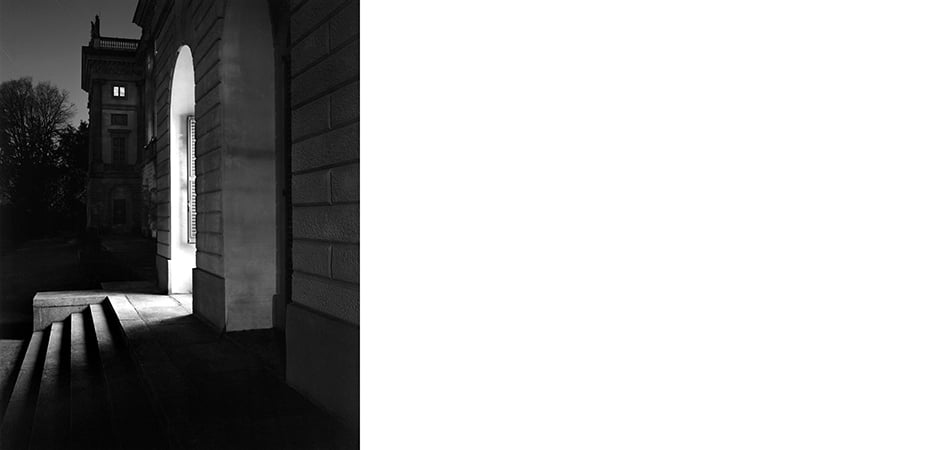
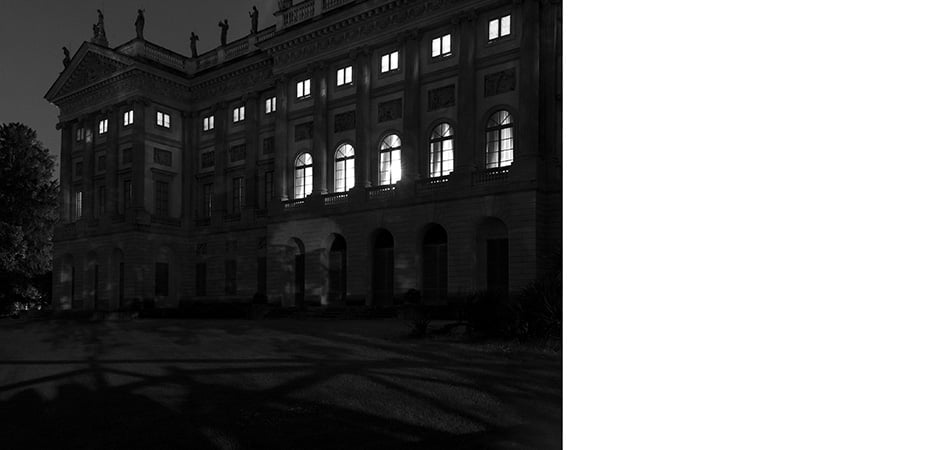
For me, it was a natural encounter rather than a constraint. When I was asked to photograph Villa Reale, the PAC and their gardens, I immediately proposed approaching the commission in a way that would remain consistent with what I have been doing for years: exploring how photography transforms places rather than simply describing them. Photographing at night places that are normally bustling with visitors during the day is a practice I have pursued for many years, and one that continues to surprise me.
You were born in Stockholm, your mother is Swedish, but you grew up and studied in Milan. Has belonging to two cultures influenced your work?
It certainly has, although it is difficult to measure to what extent. Growing up between two cultures teaches you to look at things from more than one perspective, never taking for granted that there is only one frame of reference or a single interpretation. Milan is my city, but having been born elsewhere has probably left me with a certain inclination towards wandering, which I also recognise in my interest in images that have travelled, changed context and lost their original “home”.
What is your relationship with the city of Milan and with the places you were commissioned to photograph? What is your perspective on urban spaces?
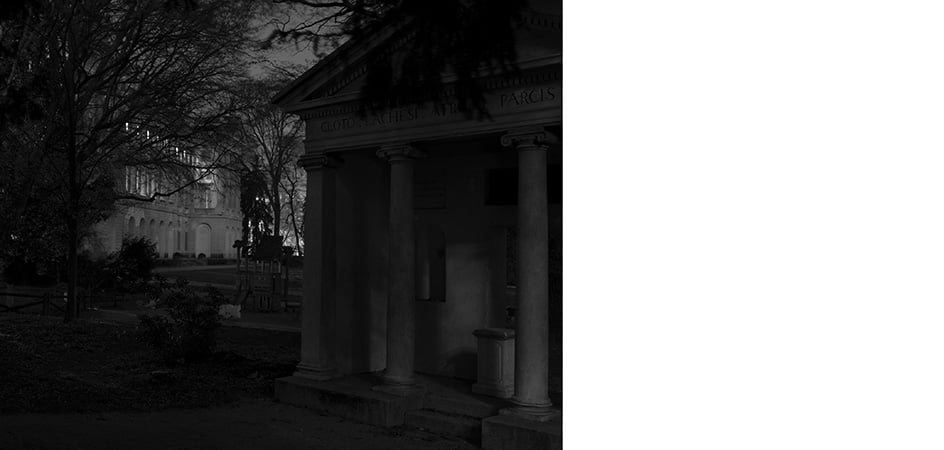
Milan is the city where I grew up, where I studied, and where I live and work. I know it well, and yet some of its places continue to surprise me. I have spent a great deal of time at Villa Reale and the PAC, but photographing them at night, from the gardens, forced me to see them differently: not as familiar buildings, but as architectural forms whose very nature changes in the darkness. I am not interested in describing urban space; I am interested in the moment when a place ceases to be what it is and becomes something else. That is what happens with long exposures, with the night, and with the large-format camera.
What were the challenges, if they can be called that, of documenting these spaces at night using a large-format camera?
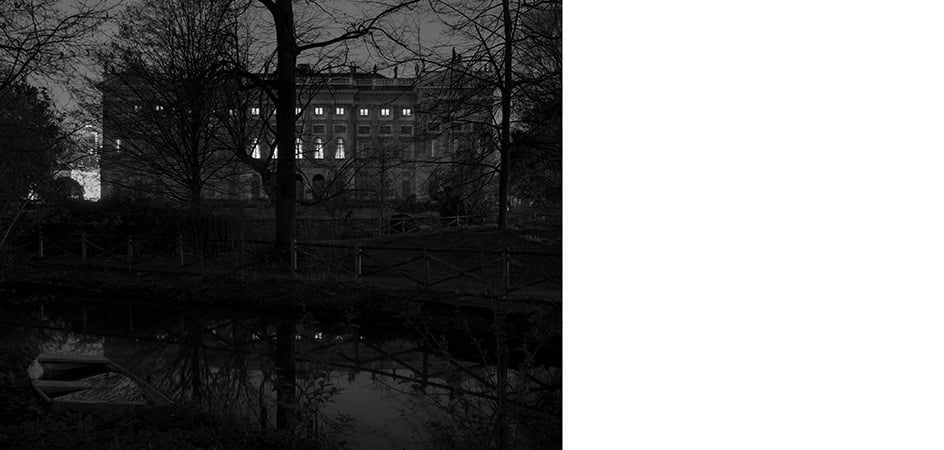
The large-format camera is a slow instrument that requires time and patience. At night, you can see almost nothing on the ground glass, so someone has to signal with a torch to help with focusing, and then you simply wait. Exposure times are measured in minutes, sometimes even hours (one of these photographs required an exposure of one hour and fifteen minutes). There are many variables – residual light, the wind, something moving within the frame – and it is all too easy for something to go wrong. Yet it is precisely this dimension of waiting and uncertainty that interests me: the real work lies in the waiting. Photography begins there, in that suspended time when you cannot see what you are photographing and only discover the subject once the negative has been developed.
The photographs you produced of Villa Reale, the PAC and the gardens form part of the Playgrounds series. Could you tell us about the origins of this project?
Playgrounds began in 2005 following a chance encounter. One winter night I was walking past a playground in the Alps. It was bitterly cold and, beneath the glow of a streetlamp, the place suddenly appeared to me in black and white. I wanted to capture its stillness and its sombre atmosphere. I returned the following night with my large-format camera. The experience proved truly revealing of the nature of the photographic medium. At night, playgrounds, empty swimming pools and recreational structures lose their function and become abstract, suspended places. Colour disappears, the children are gone, and places that are noisy and full of life during the day reveal a darker, quieter side. It demonstrates how time and light, acting together upon a photosensitive material, make it possible to see more than the human eye can perceive.
The photographs you have produced are five nocturnal images, evocative and imbued with mystery. By reversing the viewpoint – all the photographs were taken from the gardens, from the private and theoretically “inaccessible” side of the two buildings – you draw us into a more intimate, more personal, almost romantically voyeuristic dimension. One cannot help wondering who lives behind that illuminated window…
Yes, that was exactly what interested me. Photographing from the garden means remaining outside while looking in. It is a position that reverses the usual perspective from which a public building is viewed. Villa Reale and the PAC are normally seen from the outside; people enter them and move through them. I wanted to remain beyond the threshold, in that theoretically inaccessible space, and observe them from there. That illuminated window suddenly becomes a metaphysical question. Photography does not provide an answer; it opens up a space for the imagination. It is that voyeuristic dimension, as you describe it – that tension between the visible and the invisible – which, for me, lies at the very heart of photography.
How does a project like this unfold? How many days did you devote to the shoot? How many photographs did you take? How much time is dedicated to the final stage?
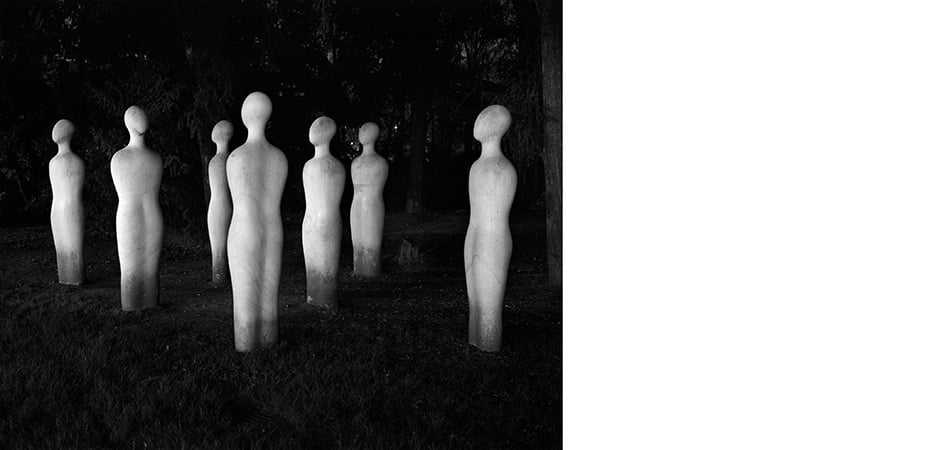
Before taking any photographs, I always carry out daytime site visits. I study the light, the forms and the possible viewpoints. I then return at night, often more than once, to observe how the place changes in the darkness. Only at a third stage do I arrive with my equipment and a few friends who help me illuminate the reference points needed for focusing. Working with a large-format camera and very long exposure times, I devoted three nights to photographing the two buildings, the park and The Seven Sages by Fausto Melotti. The total number of photographs is relatively small – large-format photography does not encourage quantity – but every negative is the result of careful waiting and a deliberate choice. The final stage is equally time-consuming: developing the negatives, producing the silver gelatin prints and assessing the final result.
The jury wrote: “Her distinctive working method, combining the roles of researcher, image-maker, curator and collector, fosters an ongoing reflection on the role of the artist within the landscape of contemporary culture…” Do these different facets of your practice also come together in a project like this?
For me, these roles are never separate. Even in a project like this, which is very much centred on photography, the dialogue between these different facets of my practice was always present. I was working with places steeped in history and meaning, while at the same time incorporating those images into a series I have been developing for the past twenty years. I could not have done so without bringing with me everything I know.
To what extent is your creative imagination shaped by the extensive research and collecting that you pursue?
Very much so. Aby Warburg spoke of the engram – the “memory of things seen”: a cultural visual memory that shapes the way we look at the world. Over the years, I have built an archive of thousands of images, and that archive permanently inhabits my gaze. It is an ongoing conversation with the history of the photographic medium.
One of the aims of the Orbital Cultura Award is to provide Italy’s historic museums with new images that go beyond mere documentation, offering contemporary portraits of our civilisation. What role do Italy’s historic museums play today, and how can photography contribute to the way they are interpreted and narrated?
Italy’s historic museums preserve layers of time and meaning unlike anywhere else. The risk is that these layers remain enclosed within themselves, turning the museum into a monument rather than a living place. Photography – and especially photography that goes beyond mere documentation – can open up new perspectives. It can reveal these spaces in unexpected ways, restoring their material and atmospheric richness and allowing us to see what the everyday gaze so often overlooks.
Are there any anecdotes or interesting stories about the Award or the photographic commission that you would like to share?
During the nights of the shoot, almost by magic, the sky was so exceptionally clear that we could see an extraordinary blanket of stars even from the centre of Milan. They were wonderful evenings. We had a fantastic team; we searched, talked, hoped we had judged the exposure times correctly, and thoroughly enjoyed the experience.
Future projects?
I am continuing to work on the Vater series, a photographic investigation into the Mensur, the ritual duelling tradition of student fraternities in Germany, Austria and Switzerland. It brings together a body of images spanning from 1892 to 1968, complemented by a number of contemporary photographs. It is a project that I feel is particularly urgent to present. Those men laughing while their faces are disfigured by blood strike me as a powerful metaphor for the violence of the historical moment we are living through. In 2027, I will present a solo exhibition at MASI Lugano, featuring a project that I am developing together with Letizia Ragaglia and Francesca Benini.